As a marketing consultant, it’s easy to criticise a website.
No site is perfect. So, based on our biases, we can point to whatever we notice as wrong and emphasise its importance, using it as indelible proof that a new website is needed.
In fact, we’re incentivised to do so.
It’s no secret that website projects can be extremely profitable for agencies. When a potential client expresses doubt about their site, it’s very rare to hear ‘Woah, hold on there, let’s work on a smaller, less expensive version of this’.
Instead, you hear ‘Yes, you’re right, let’s do X, Y, Z, and why not a podcast while you’re at it?’.
For some clients, this approach is great. They have the budget and they want an enthusiastic partner to show up with energy and creativity, no matter the cost.
But for others, budget and time are a real issue. They would rather take on some of the analysis and decision making themselves. They want to understand, not just delegate.
Neither way is inherently right or wrong, but people often don’t know there’s a choice.
My goal with this guide is to empower people to understand the nuances of what makes commissioning a new website justified or not.
1. What must the site help someone do?
Finish this sentence: “Our website must help [which visitor] do [what].”
Maybe it needs to show referred prospects that you handle their kind of work, and find the right person to speak to.
Or maybe a new visitor who’s never heard of you may need to understand what you offer.
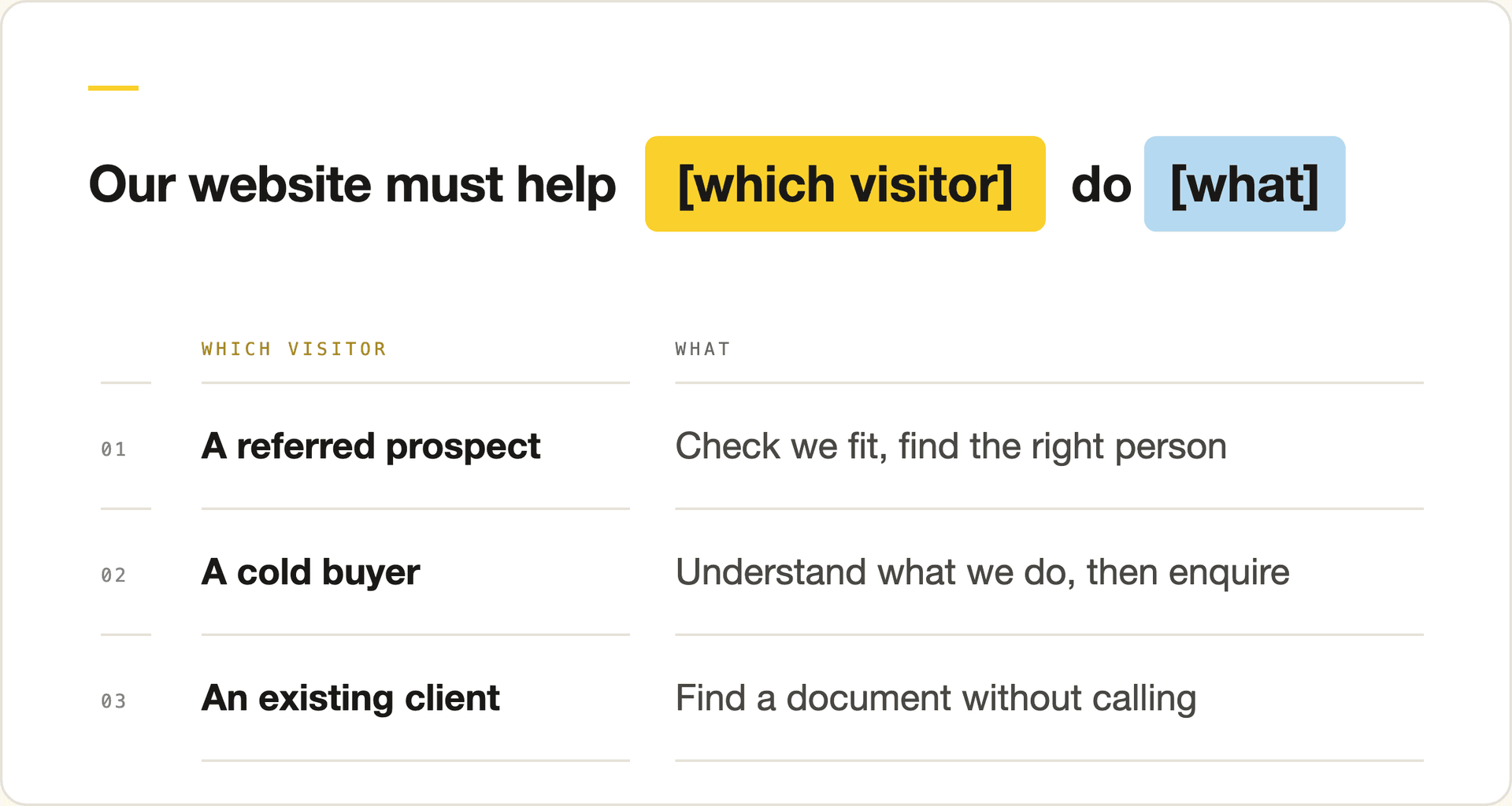
The job determines which problems matter.
2. Where does it fail for that visitor?
Open the site on your phone and give yourself ten minutes.
Look at the first screen, follow one relevant service page, then try to make an enquiry.
Can you tell what the firm does and whom it serves? Is there anything concrete behind its claims? Are its people and services current? Where do you hesitate or reach a dead end?
Ask someone unfamiliar with the firm to try the same route. Your own knowledge can fill gaps in the site without you noticing.
In my 2026 audit of 28 Jersey financial services firms, 12 failed a first-screen test: a cold visitor could not tell what the firm did and who it served.
3. What is the smallest useful change?
Name a change that addresses the failure you found. It might be a clearer opening, evidence brought forward from a buried page, a more specific service page, or an enquiry route that works.
I recently worked with a firm whose homepage said little about its actual work, although useful detail and credentials were already elsewhere on the site.
By simply bringing that substance forward, the site immediately became more powerful.
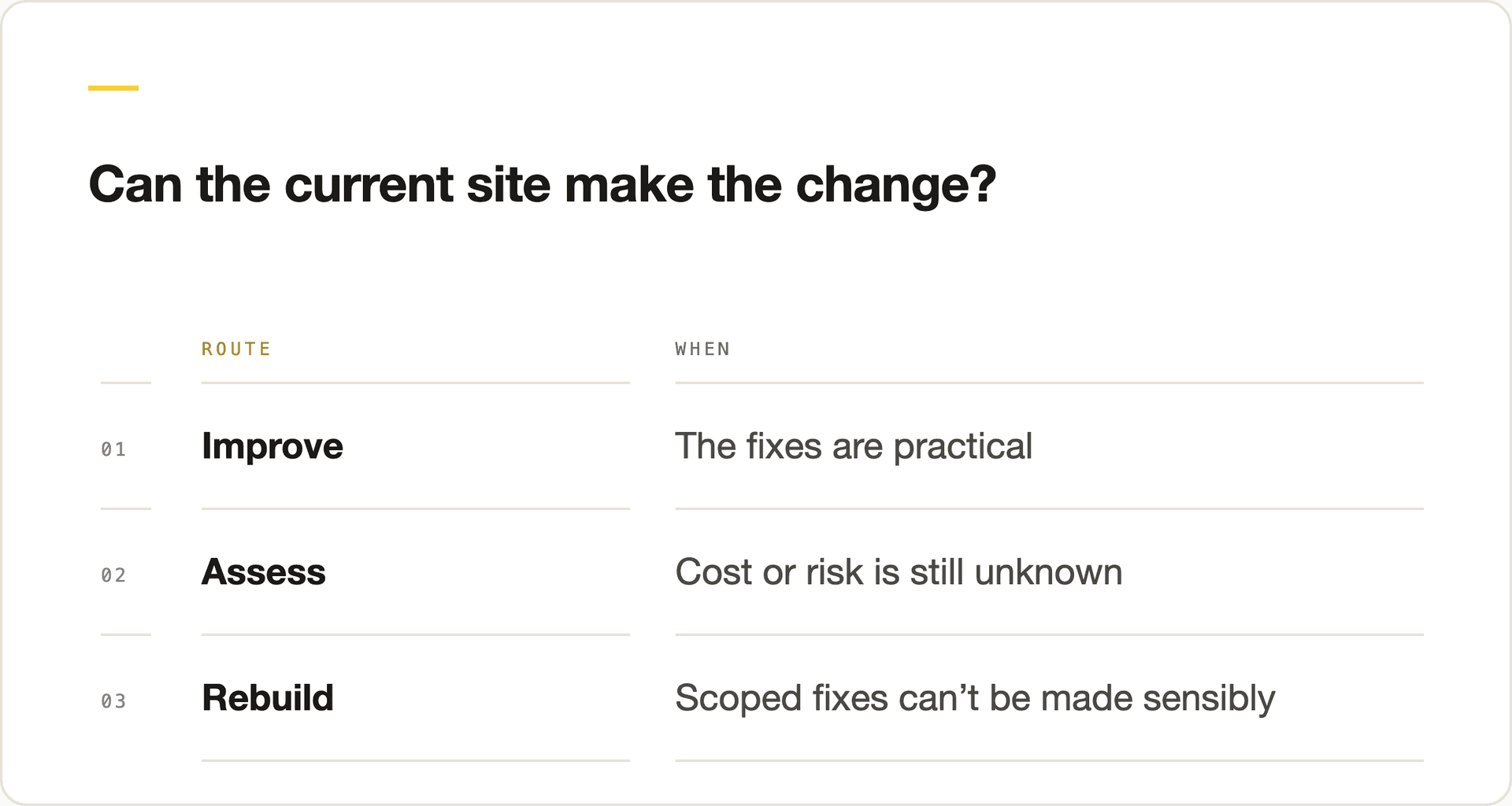
4. Can the current site make that change?
Put the proposed fixes to whoever maintains the site:
- Can we make these changes here?
- What would they cost, and how long would they take?
- What technical or security risks would they create?
- If they recommend a rebuild, ask which specific changes make repair a bad idea, and why.
Then choose your route.
- Improve if the fixes are practical.
- Assess if cost or risk is still unknown.
- Rebuild if the necessary changes have been scoped and the current site cannot deliver them sensibly.
If you’re weighing up a rebuild, book a Clarity Call. Bring the site and one task it must help a visitor complete. We can pin down the problem and the questions your developer or agency needs to answer before you commit.
Part of Website Services.