
We audited 20 Jersey law firms across 10 criteria. The findings were worse than we expected.
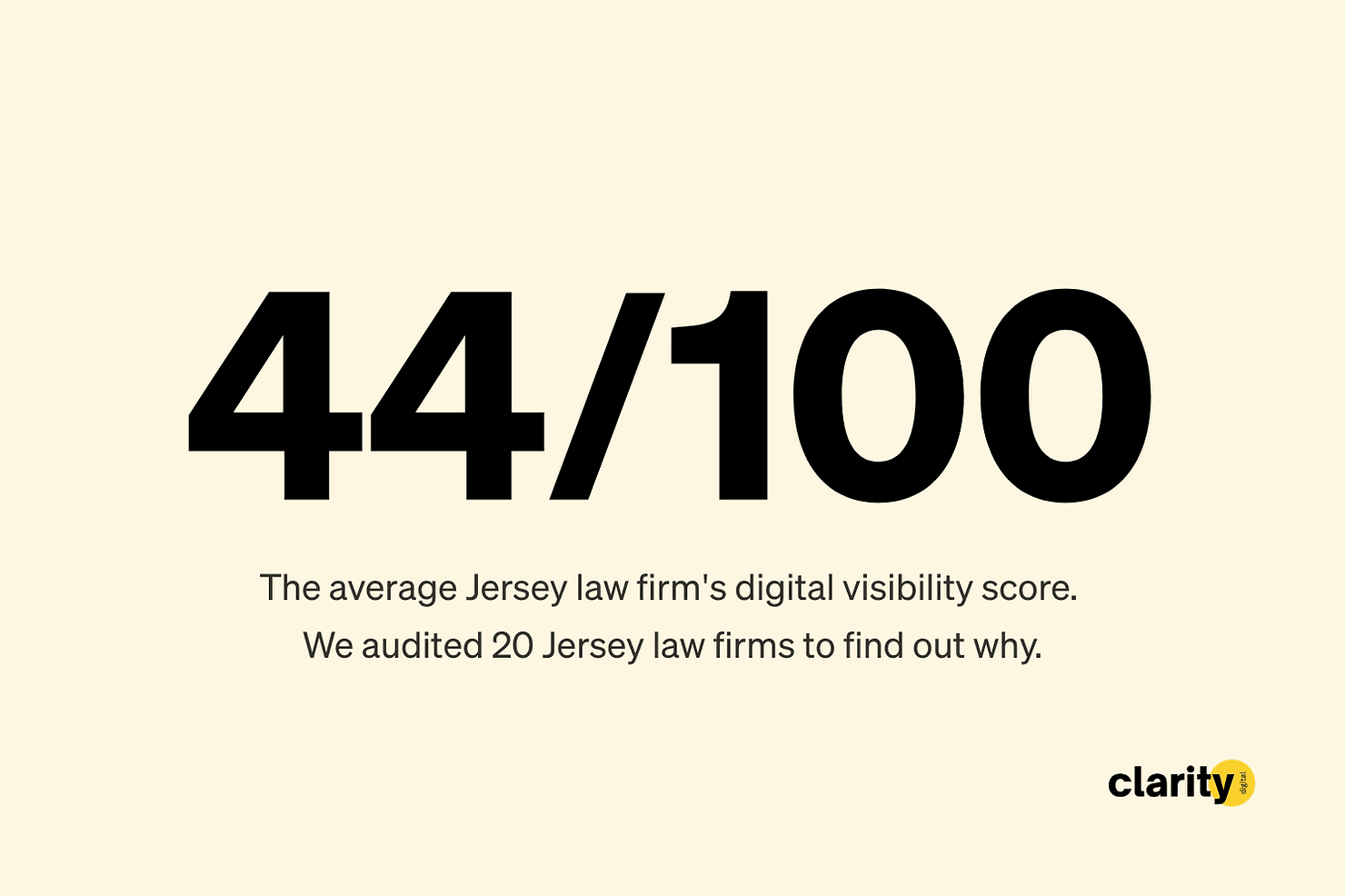
Clarity Digital benchmark score showing Jersey law firms averaging 44 out of 100 for visibility.
Somewhere in London, a private client solicitor is sitting at her desk with a straightforward task. A long-standing client has asked her to recommend a Jersey law firm for some estate planning work.
She has two or three names in mind - firms she's heard of, firms that have come up in conversation at events over the years.
Before she picks up the phone, she does what anyone does in 2026. She googles them.
The first firm has a clean, current website.
She finds the relevant partner in under thirty seconds, reads a short article he wrote last year on exactly the kind of work her client needs, and notes that the firm's Google profile looks active and well-maintained. She feels confident. The introduction reflects well on her.
The second firm's website takes a moment to load.
The team page lists a senior partner who, she happens to know, left eighteen months ago. There's no recent content, no clear articulation of what makes them different, and no obvious way to make contact beyond a generic form. She moves on.
Nobody at the second firm ever knows this happened. Their pipeline is quietly, invisibly thinner than it should be - and the cause never shows up in any meeting or report.
This is the silent shortlist. And it is happening, right now, to most Jersey law firms.
Why We Did This
I've worked with professional services firms in Jersey long enough to notice a pattern. The best ones - the sharpest lawyers, the most respected names - often have a marketing problem they know about but haven't solved.
In person, they're credible, considered, and authoritative. Online, they frequently tell a smaller story than the firm deserves.
I wanted to understand how widespread this gap actually was. Not through assumption, but through data.
So we audited 20 Jersey law firms - all with teams of five or more people, spanning the full range of practice areas from family law and private client work to litigation, corporate, and offshore legal services.
We scored each firm across 10 criteria, on a scale of 0 to 100, giving a maximum possible score of 100.
No firm names appear in the findings below. The story here is about the market, not about embarrassing individuals. Several of the firms we audited are genuinely excellent at what they do. The gap between their quality in practice and their visibility online is the point.
How We Scored Them
Each firm was assessed independently across the following criteria:
Website Freshness
Is there any evidence the site has been updated in the last 12 months?
Team Page Accuracy
Do the people listed still work there? Cross-referenced against LinkedIn.
Mobile Experience
Does the site render properly and feel intentional on a phone?
Intermediary-Facing Messaging
Does the site acknowledge and speak to the people who refer work - other lawyers, family offices, private banks - or only to end clients?
Original Thought Leadership
Has the firm published any substantive original content in the last 12 months?
LinkedIn Presence
Does the firm have an active company page with content of genuine value to a referral audience?
Search Visibility
Does the firm appear in search results for relevant terms without already knowing its name?
Proposition Clarity
Can a stranger understand within 10 seconds what the firm does, for whom, and why it matters?
Google Business Profile
Is the profile complete, accurate, and recently maintained?
Clarity of Next Step
Is there a clear, low-friction way for a new contact to take action
Scores were applied consistently. When in doubt, we scored conservatively.
What We Found
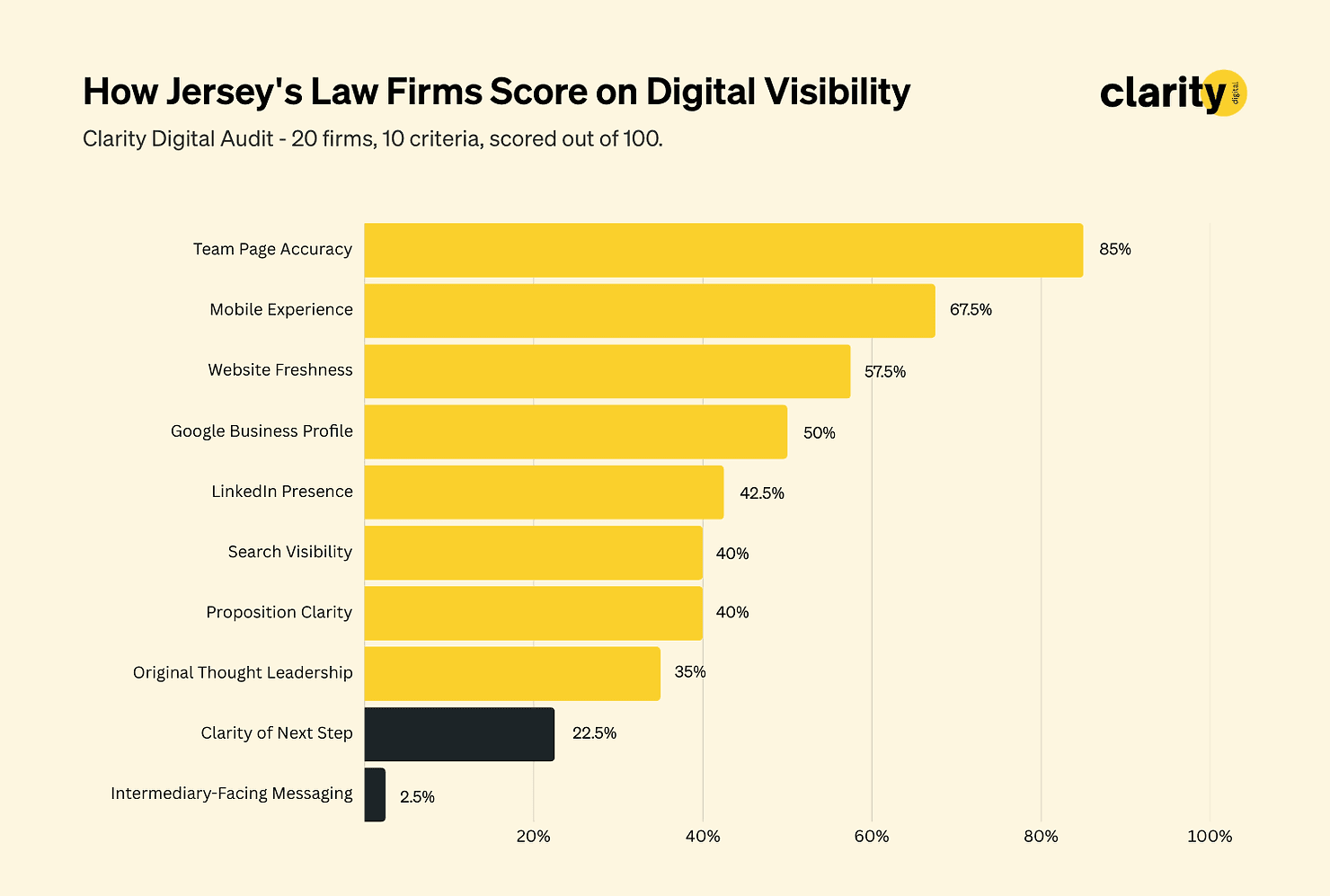
Bar chart highlighting the most common visibility issues on Jersey law firm websites.
The average score across 20 firms was 44 out of 100.
Less than half marks. Across the board.
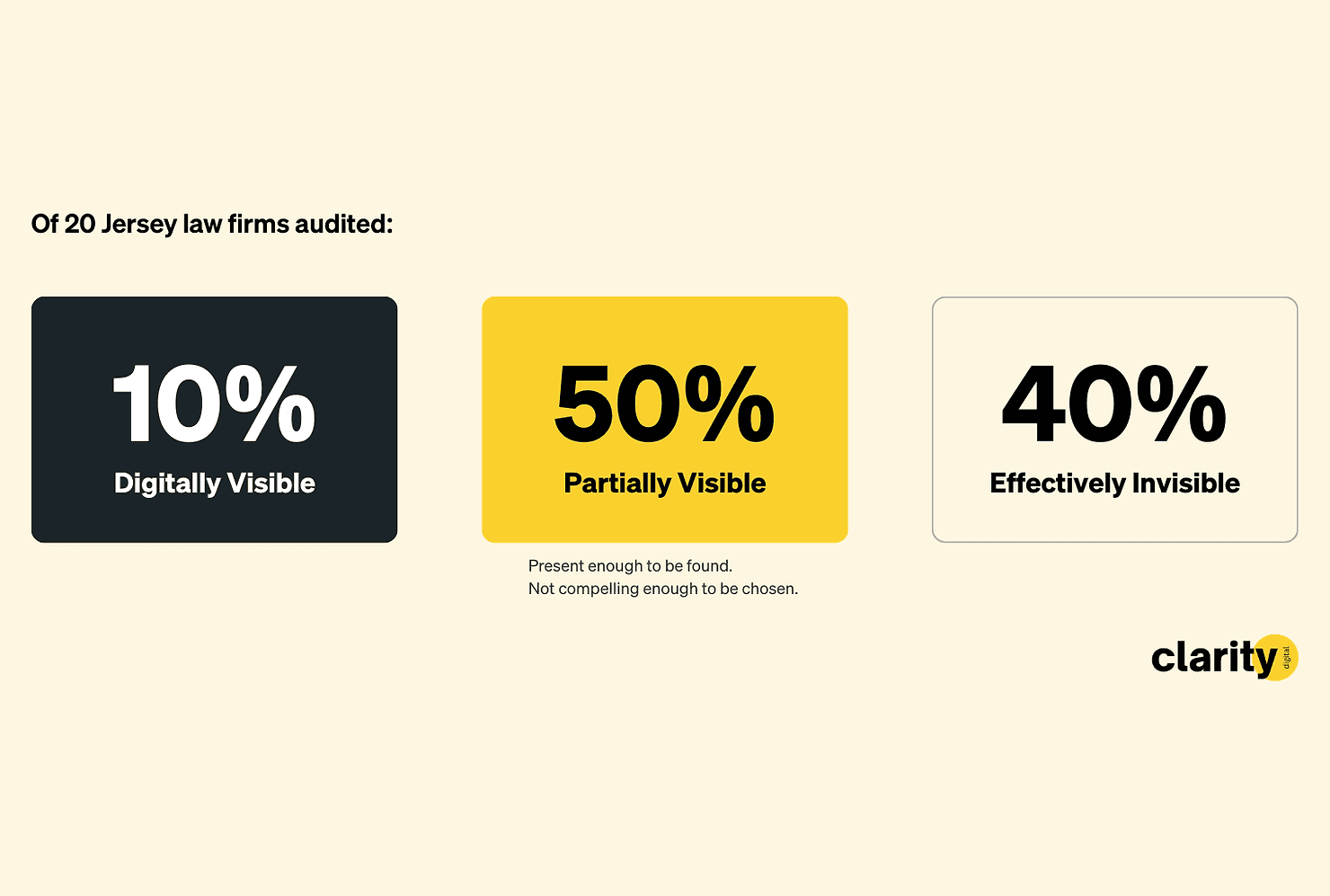
Only 2 firms out of 20 - 10% of the sample - scored highly enough to be described as digitally visible. These are firms where a referral partner googling from London or Singapore would find a coherent, credible, current presence that justifies making an introduction.
8 firms out of 20 - 40% - are effectively invisible. A referral partner conducting even a basic digital credibility check would find enough friction, absence, or incoherence to quietly move on.
The remaining 10 firms sit in the middle: partially visible, present enough to be found, but not compelling enough to be chosen with confidence.
The pattern is clear. Jersey law firms are reasonably good at the basics - keeping their team pages accurate, maintaining a functional mobile site. But on every criterion that actually influences a referral decision, the market falls apart.
The Five Most Striking Findings
1) 19 out of 20 firms score zero on intermediary-facing messaging.
This is the single most significant finding in the entire audit - and the one that reveals the most fundamental misunderstanding of how professional services firms actually grow.
Not one firm in our sample speaks clearly to the people who refer them work. Their websites are written entirely for end clients.
There is no section, no page, no line of copy that acknowledges the London solicitor, the Singapore family office, or the Geneva private bank who might be considering making an introduction.
This matters because referral partners are not end clients. They have different questions, different concerns, and different things they need to see before they're willing to put their own reputation on the line.
The firms that ignore this audience entirely are, in effect, invisible to the people most likely to bring them significant work.
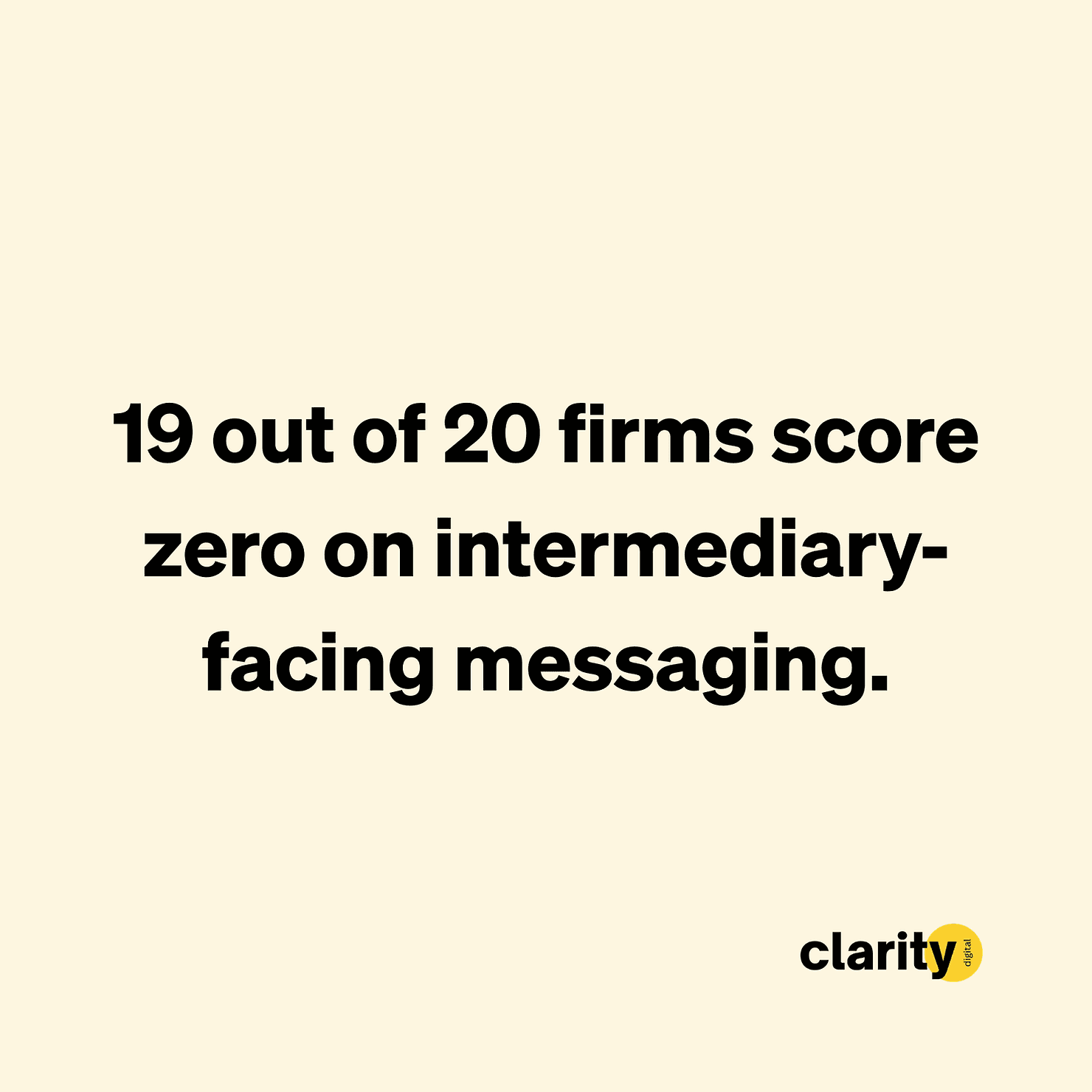
Statistic showing that 19 out of 20 Jersey law firms need clearer messaging on their websites.
2) 12 out of 20 firms make it unclear what to do next.
Only one firm in the entire sample makes it genuinely easy - a clear, specific, low-friction invitation to make contact. Twelve firms score zero. Seven manage a partial effort.
A referral partner lands on the website. They're broadly interested. They want to understand whether this firm handles the kind of work their client needs. And then - nothing. A generic contact form. No named partner to reach. No obvious first step. The door is not open.
In a market where the entire commercial model depends on someone choosing to make an introduction, the absence of a clear next step is not a minor oversight. It is a direct barrier to growth.
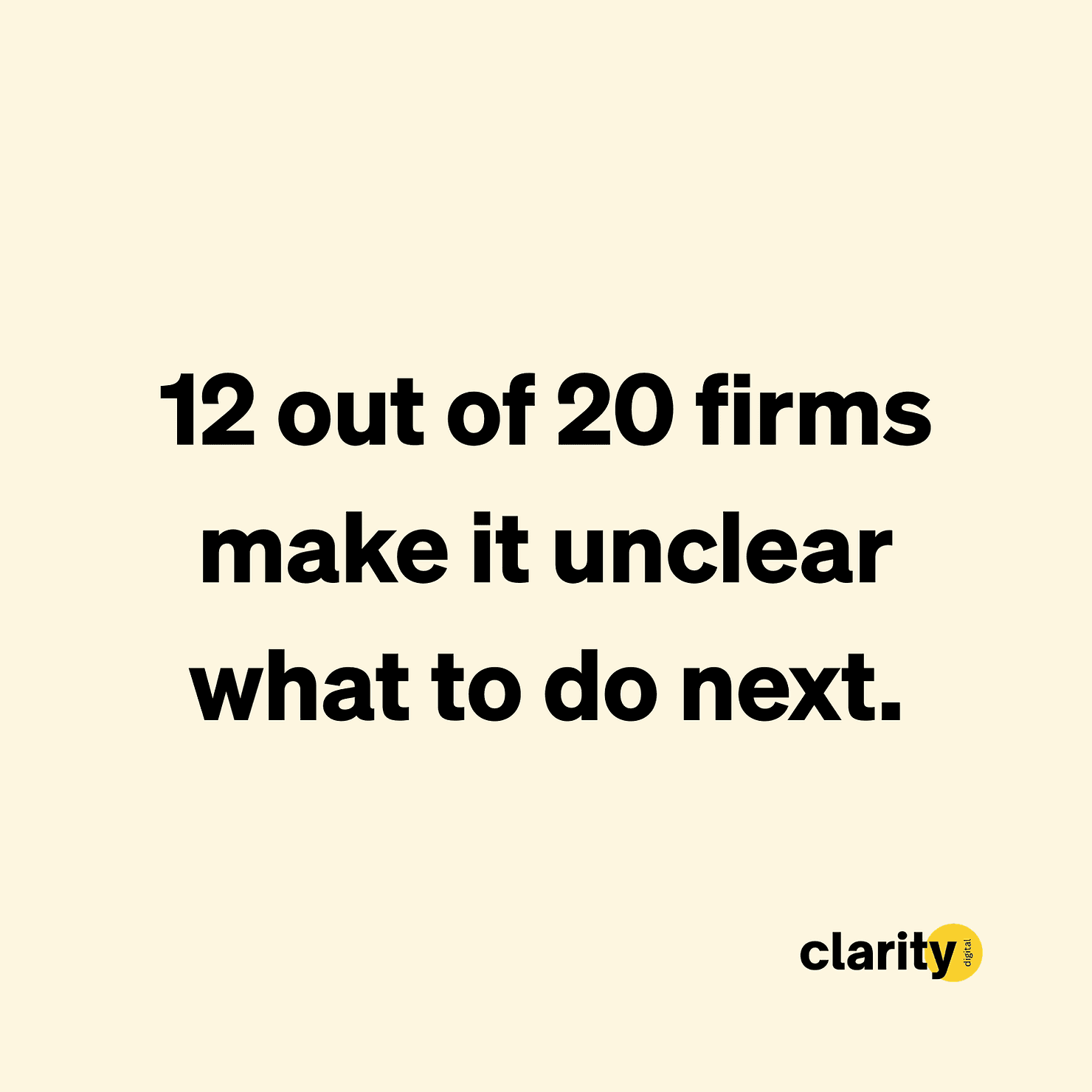
Statistic showing that 12 out of 20 law firms don't explain what to do next.
3) The messaging is a maze, not a journey.
One of the most consistent patterns across the sample was the difficulty of understanding, quickly and clearly, what a firm actually does and who it does it for.
Many of the firms audited had websites with dozens of pages - extensive, labyrinthine structures that required significant navigation before a practice area, let alone a specialism, became clear.
Abstract claims appeared frequently: "we are committed to excellence," "our clients come first," "we provide expert legal advice." Statements that could appear on any firm's website, anywhere, without changing a single word.
A referral partner working quickly - matching a client need to a firm in under a minute - cannot afford to get lost. Ambiguity does not build confidence. It creates friction at exactly the moment a decision is being made.
4) 8 out of 20 firms have published nothing original in the last 12 months.
Thought leadership in this context is not about content marketing in the conventional sense. It is about proof of expertise.
A named partner who has written a well-argued piece on a relevant area of law gives a referral partner something concrete to point to when a client asks: why this firm?
Eight of the firms we audited have published nothing. Ten have published something thin or infrequent. Only two have a genuine, consistent content presence.
What makes this finding more pointed is the contrast with team page accuracy - 16 out of 20 firms maintain a perfectly accurate team page.
These firms invest in showing who their people are. They just don't show what those people think, know, or believe. The result is a directory, not an authority.
5) Firms with an active LinkedIn presence score 65% higher overall.
Firms with any meaningful LinkedIn presence averaged 55.5 out of 100. Firms with no LinkedIn presence averaged 33.5 out of 100. That is a 22% gap - not because LinkedIn alone drives visibility, but because firms investing in LinkedIn tend to be investing across the board.
The absence of LinkedIn is a reliable indicator of broader digital neglect.
Half the firms in our sample - 10 out of 20 - have no meaningful LinkedIn company presence at all.
What Referral Partners Are Actually Looking For
Understanding why these gaps matter requires understanding how referral relationships actually work in practice.
When a London solicitor, a Singapore family office, or a Geneva private bank is considering introducing a client to a Jersey law firm, they are not conducting a detailed due diligence exercise.
They are doing a rapid credibility check - and they are doing it quickly, often under time pressure, with the implicit question: will this introduction reflect well on me?
Three things shape that assessment.
1) Can I find them, and do they look the part?
The digital presence needs to pass a basic coherence test. Current, consistent, professional.
A website that looks as though it was last updated three years ago, or a team page listing people who have moved on, introduces a small but real note of doubt.
For a referral partner whose own reputation is attached to the introduction, doubt is enough to move on.
2) Can I understand what they do in under a minute?
Referral partners are matching a specific client need to a specific firm. A website that requires significant navigation to establish a practice area, or that describes its services in language so broad it could apply to any legal firm in any jurisdiction, fails this test.
The firms winning referral work are the ones where the answer to "do they handle this kind of work?" is immediate and unambiguous.
3) Is there any evidence these people actually think about this area of law?
A published article, a clear point of view, a piece of commentary on a relevant development - these are shortcuts to trust for someone who cannot rely on a personal relationship.
In the absence of original thinking, there is nothing to differentiate one technically competent firm from another. The referral goes to whoever the partner already knows, or whoever made the decision easiest.
Visibility scoring chart for Jersey law firms
What Good Actually Looks Like
The two highest-scoring firms in our sample - both scoring 16 out of 20 - demonstrate that getting this right is achievable without a large marketing budget or a dedicated in-house team.
Both have websites that are clearly and recently maintained. Both have active LinkedIn presences. Both make it reasonably easy to understand what they do and to take a next step.
Neither has cracked intermediary-facing messaging - no firm in our sample has - but both are significantly more findable and more credible than the market average.
The gap between the top two firms and the bottom five is not a gap of resource or reputation. It is a gap of intention. The firms performing best have simply made a series of deliberate decisions about how they present online. The firms performing worst have, in most cases, not made those decisions at all.
A credible digital presence for a Jersey law firm does not require a complete rebuild. It requires four things:
- A clear and current articulation of what the firm does and who it does it for
- A content presence that demonstrates genuine thinking in the relevant practice area
- An active and maintained LinkedIn company page
- A clear, low-friction way for a new contact to take the next step.
None of these are technically difficult. All of them require someone in the firm to decide they matter.
The Bottom Line
Jersey law firms are not bad at law. They are bad at being found by the people who refer it.
The silent shortlist is real. Referral partners are making decisions about your firm based on what they find online - and most of what they find is giving them a reason to move on.
The fix is not complicated. Clear positioning, a content presence that demonstrates genuine expertise, an active LinkedIn page, and an obvious next step. Four things. None of them technically difficult. All of them requiring someone to decide they matter.
If that someone is you, read about the Clarity Reset - or if you're ready, a 15-minute call is the place to start.
James Logue is the founder of Clarity Digital, a strategic marketing consultancy based in Jersey that helps professional services firms bring their external presence up to the standard of the business behind it.
Need the same clarity in your own firm?