
Google's job is to keep users happy so they come back.
Our job is to show up as the answer that makes them happy.
Lucky for us, the algorithm isn't magic - think of it as a rule‑book. Learn the rules, play the game, win the clicks. This guide shows you how in three moves:
1. Pull live data on what people Google about your business
2. Plug the gaps your competitors ignore
3. Publish a single, laser‑focused post that can outrank a month of spray‑and‑pray blogging
It's the same Stage 1 analysis we run for every Clarity client - distilled from hundreds of hours of testing.
New to SEO, rusty, or just squeezing more out of existing posts? You're in the right place. (Quick‑wins piece lands later this month.)
Quick Navigation
-SEO in Jersey is hard (but easy?)
-Step 1 - Tailor your keyword list
-The one-shot prompt (copy-paste)
-Step 2 - Check where you rank
-Step 3 – Spot high‑potential topics
-Step 4 – Write content that sticks
Why this guide beats a random brainstorm
This method turns your own live ranking data into a content plan. One post written with it can out‑perform a hundred gut‑feel posts, because it:
- Targets phrases your customers actually Google
- Fills gaps your competitors ignore
- Snowballs authority with every update
In a nutshell: This free framework turns your site data into sustainable keyword growth - bringing the right traffic, not just any traffic. With AI chatbots and Google's AI snippets vacuuming clicks, owning the #1 answer is everything.
Drake meme—Drake rejecting 'Brainstorming 100 random blog ideas' and approving 'Stealing keywords from your own search data
SEO in Jersey is hard (but easy?)
Low search volumes, fierce competition, and the big tools (Semrush etc.) ignore Jersey‑specific data … yet the upside is huge if you nail the gaps. The audit below shows you exactly how - no guesswork, no jargon.
Outcome: a laser‑focused list of content ideas that can put you in the top slot within days. #1 grabs 30–40 % of clicks, so even one win pays dividends.
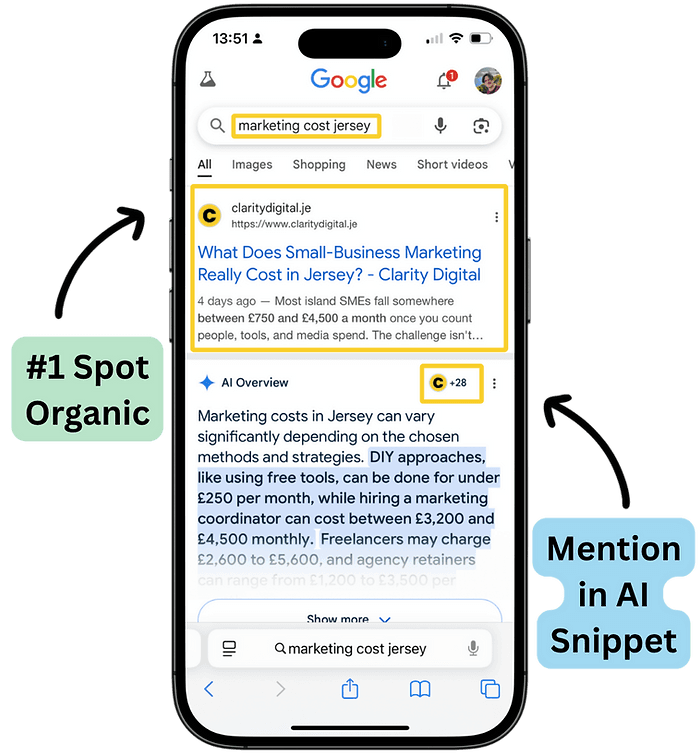
Yes, this stuff works - Clarity got #1 and the AI Overview in just four days.
Plenty of SMEs can't hire an agency. By revealing our approach, we level the playing field - and if you outgrow the DIY stage, Clarity's here for you. Win‑win.
You'll need
- A website
- Free ChatGPT account
- Somewhere to take notes
- Spreadsheet (Google Sheets works)
Step 1: Tailor your keyword list
- Collect raw material - Copy your About, Services, and Home copy into a doc. Screenshot key pages if you like (GoFullPage extension for full web-page screenshots).
- Paste into ChatGPT with the one‑shot prompt below (replacing the [PASTE EVERYTHING HERE] with your notes/screenshots).
- Get three outputs: a customer‑view SB7 BrandScript, 12‑15 "They Ask, You Answer" queries, and the queries bucketed into Branded / Broad / Qualitative (top three bolded).
We ran this process with a local sewing studio - Rachel's Textiles Studios. Here's how it looks. The same logic applies equally well to professional services: a Jersey law firm would paste in its practice area pages and let ChatGPT surface the questions prospective clients are actually Googling — things like "how long does a Jersey trust take to set up" or "do I need a Jersey advocate for a property purchase."
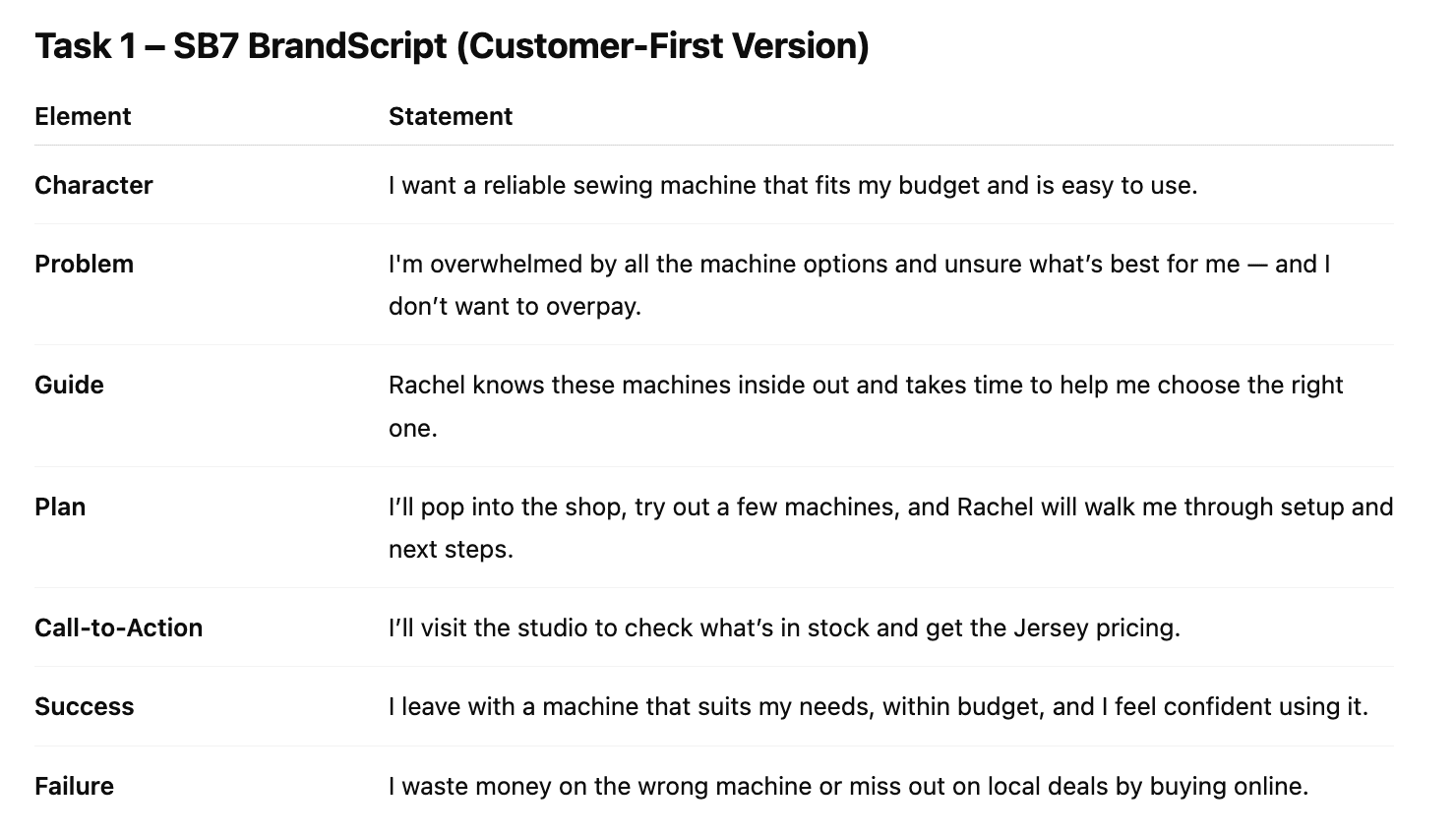
Here's the customer‑first BrandScript ChatGPT spat out in 30 seconds.
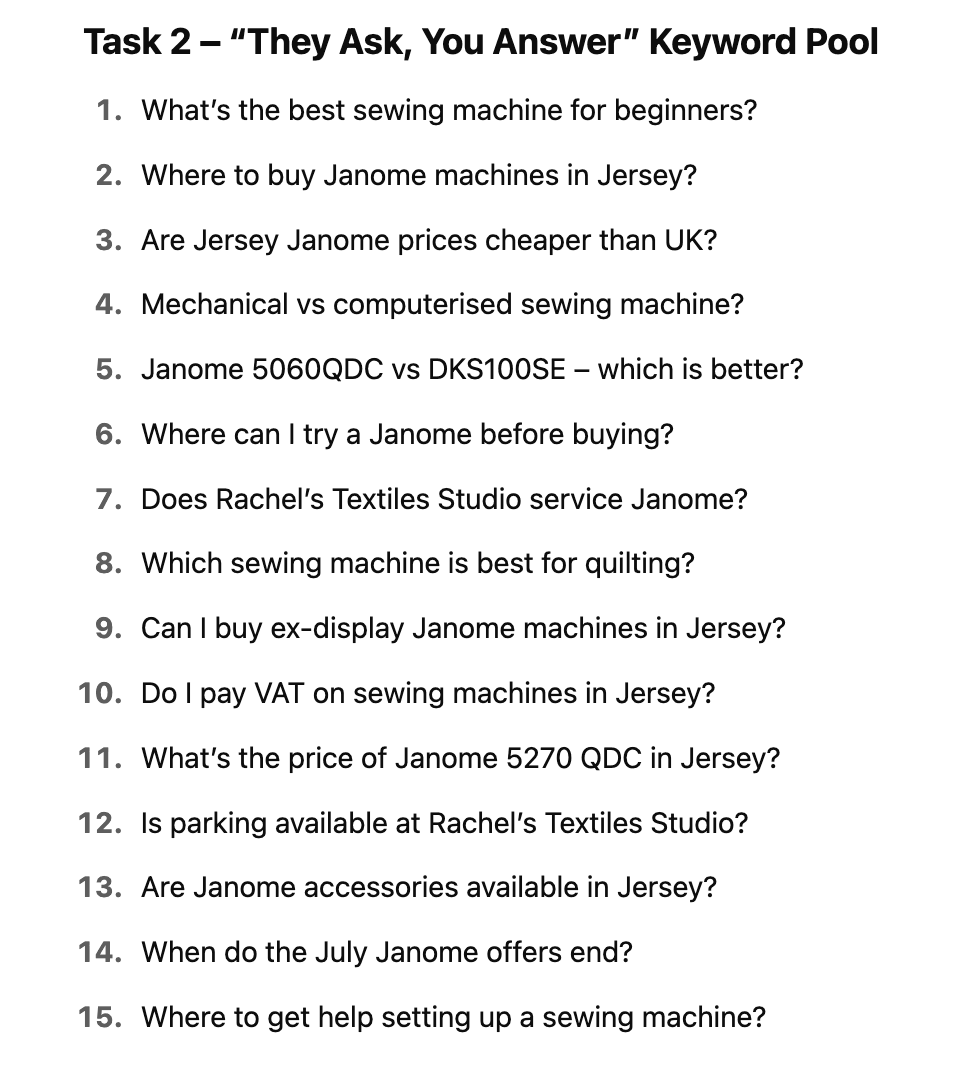
A list of searches that will all be relevant to your business.
The one-shot prompt (copy-paste)
Your mission**:** turn my raw material into an SB7 table, a killer question list, and a priority matrix—Jersey market, plain English. My raw material (copied from our website, brochures, screenshots, etc.):
[PASTE EVERYTHING HERE]
Task 1 – SB7 BrandScript (from the customer's perspective)
Build a concise table with the seven SB7 elements: Character • Problem • Guide • Plan • Call-to-Action • Success • Failure –but write each cell in first-person ("I / we") so it reads like the story my prospect would tell themselves.
Task 2 – "They Ask, You Answer" keyword pool
Using only the info above plus common sense about my industry, list 12-15 Googleable questions my ideal buyer is likely to type at the prep / compare / ready-to-buy stages.
- No fluff (each question ≤ 90 characters).
- Mix Jersey-specific and universal queries.
Task 3 – Bucket & focus
-
Drop every question/phrase into Branded / Broad / Qualitative columns.
-
Bold the three highest-value, highest-intent terms I should track monthly. Output everything as a single block. Do NOT invent extra copy – stick to these three tasks only.
-
Open with one or two plain sentences summarising current performance and the biggest improvement gap.
-
Provide a single ranked list titled Top 10 Content Opportunities.• #1 = highest SEO upside• Each line: blog title – search term(s) it should rank for Example:
- Jersey Marketing Costs Explained – ranks for "How much does marketing cost in Jersey?" 2. …
Step 2: Check where you rank
- Open an incognito/private window (this clears cache) and Google each term.
- If you're outside Jersey, add &gl=je to the URL after searching.
- Log the position in a sheet - number, "not ranking," or any quick note.
Here's how it looked for Rachel's Textiles Studios.
| Rachel's Textiles Studios | Google Results |
|---|---|
| What's the best sewing machine for beginners? | no |
| Where to buy Janome machines in Jersey? | 1st in 'places' +1st (and 2nd!) organic |
| Are Jersey Janome prices cheaper than UK? | 1st organic and mentioned in ai snippet |
| Mechanical vs computerised sewing machine? | no - results are mostly american (uk/jersey gap here?) |
| Janome 5060QDC vs DKS100SE – which is better? | no |
| Where can I try a Janome before buying? | no (but 1st organic when adding 'jersey' to end) |
| Does Rachel's Textiles Studios service Janome? | 1st organic + mention in ai snippet |
| Which sewing machine is best for quilting? | no |
| Can I buy ex-display Janome machines in Jersey? | 1st organic, but competitor named instead in the ai snippet |
| Do I pay VAT on sewing machines in Jersey? | 4th organic (but unappealing meta title which doesn't answer the question) |
| What's the price of Janome 5270 QDC in Jersey? | 1st organic, but competitor in ai snippet instead |
| Is parking available at Rachel's Textiles Studio? | 1st |
| Are Janome accessories available in Jersey? | 1st in AI snippet, 1st (and 2nd) organic |
| When do the July Janome offers end? | no |
| Where to get help setting up a sewing machine? | 2nd ai snippet, 1st organic |
The pattern here is instructive. Rachel's ranks well on branded and transactional queries but has clear gaps on comparison and advice content. That's where the next content push should go.
Step 3: Spot high-potential topics
Paste your results into the same ChatGPT chat. Ask it to summarise your current performance and produce a ranked "Top 10 Content Opportunities" list (title + target query). Here's the prompt to use:
Here are my current Google rankings for the keyword list we built. Please: (1) summarise my current performance in two or three plain sentences, identifying my biggest gap; (2) produce a ranked "Top 10 Content Opportunities" list — each line should include a working blog title and the search query it should rank for. Rank by SEO upside, not ease of writing.
ChatGPT will do the heavy lifting. Your job is to review the list and pick the idea you can write best — not necessarily the one with the highest theoretical upside.
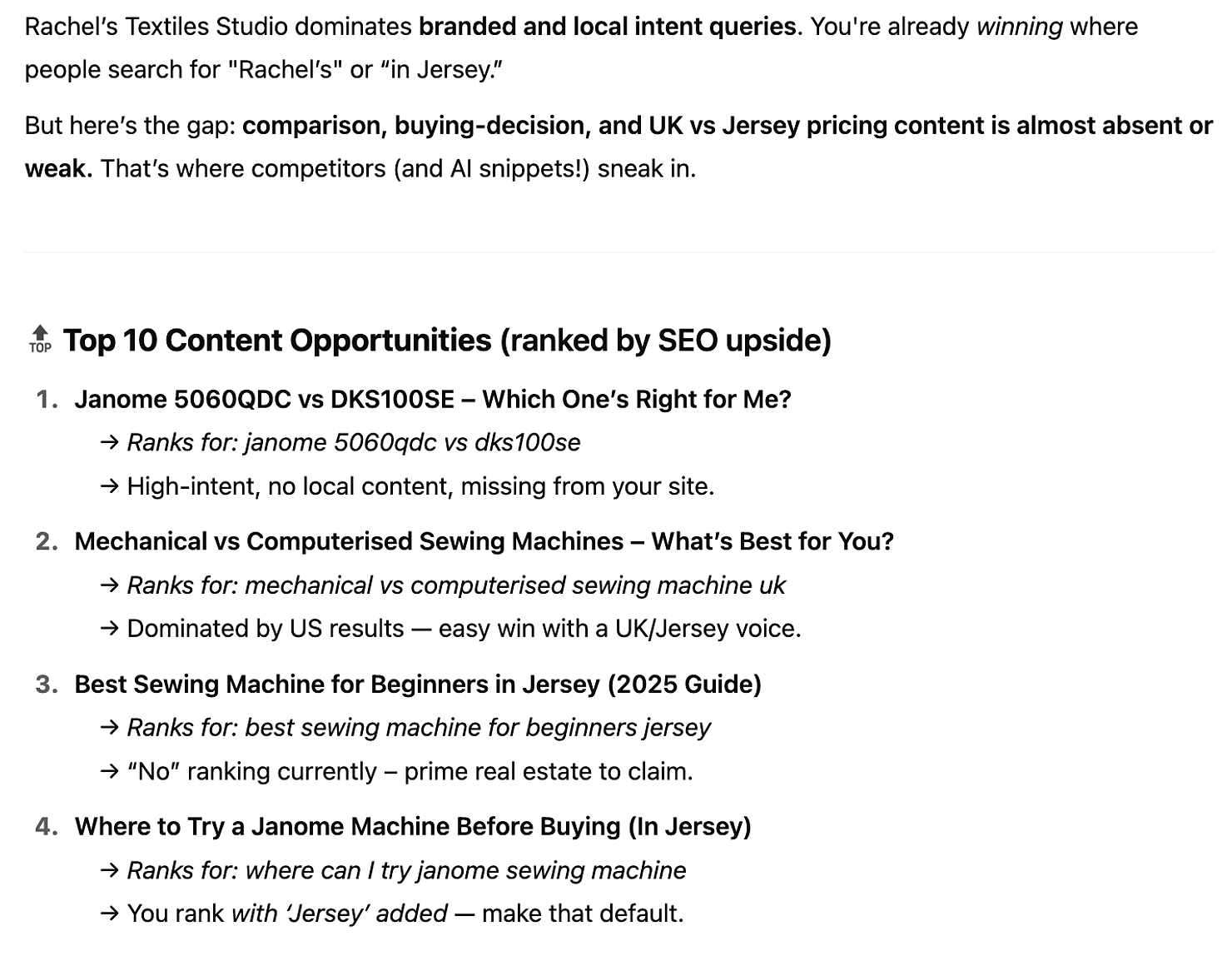
ChatGPT's gap analysis and content list.
What to look for in the output:
- Gaps where you rank 4th–10th — you're already in the game, a stronger post can push you to #1.
- Queries with no result where you clearly should be ranking — these are the fastest wins.
- Comparison or "vs." questions — these convert well because the reader is close to a decision.
For Rachel's Textiles, the clearest opportunity was a comparison post: Mechanical vs Computerised Sewing Machine — Which Is Right for You? She has no competition in Jersey on that query, genuine expertise to share, and a product range that suits both camps. One post, one gap, one hour of focused writing.
A Jersey financial adviser running this exercise would likely find similar gaps on comparison queries: "discretionary vs advisory investment management in Jersey," for instance, or "whole of life vs term insurance Jersey." These questions get asked; they're just not being answered locally.
Prioritise ruthlessly. Pick one topic. Write it well. Move on to the next only once you've published and monitored the first.
Step 4: Write content that sticks
Now for the part most people avoid. You have three options:
| Path | Risk / Reward | Best for… |
|---|---|---|
| DIY | Low risk / Medium reward | Owners who love writing |
| Outsource | Medium risk / High reward | Teams short on time |
| AI‑Assist + Human edit | Low risk / Medium‑high reward | Budget‑conscious SMEs |
Guard‑rails on AI: Draft with ChatGPT, then human‑edit for tone, facts, and flavour. Your content should be part of your identity, so write it wisely. If people spot AI content and click elsewhere, your site's time‑on‑page will plummet - Google notices.
Anatomy of a great post
Whatever path you choose, the structure is the same. Here's what separates posts that rank from posts that disappear.
Start by answering the question. Don't bury the answer three paragraphs down. Google's AI snippets pull from the first clear, direct response to the search query — usually the opening two or three sentences. For Rachel's comparison post, that means the first paragraph should tell the reader directly which machine type suits them, then explain why.
Match the format to the intent. A "vs." query wants a comparison table. A "how long does it take" query wants a numbered timeline. A "what does it cost" query wants a price breakdown. Look at what's already ranking and match (then beat) the format.
Use local proof wherever you can. For Rachel's post, that means mentioning Jersey's lack of VAT, or referencing the specific Janome models she stocks. For a Jersey fund administrator writing about regulatory timelines, it means citing the JFSC's published processing times rather than a generic UK figure. Specificity is what makes Jersey content genuinely useful — and it's what out-of-island sites can't replicate.
Keep paragraphs short. Three lines maximum. Busy readers scan before they commit. If a paragraph runs long, break it. Every H2 section should feel like it could stand alone.
One CTA, two placements. Put it mid-post and at the end. The same one. Consistency converts better than variety.
Refresh it. Add a calendar reminder for 90 days after publishing. Update any stats, tighten the copy, and reshare. Google rewards freshness — and so do readers who come back.
A worked example: turning Step 3's output into a post
Back to Rachel. ChatGPT flagged Mechanical vs Computerised Sewing Machine as her top opportunity. Here's how the anatomy applies:
- Opening answer: "For most beginners in Jersey, a mechanical machine is the better starting point — simpler to use, easier to service, and less expensive to replace if needs change."
- Format: Comparison table (mechanical vs computerised on five criteria: price, ease of use, repairability, features, resale value).
- Local proof: Jersey pricing note, mention of in-store try-before-you-buy option, link to her service page.
- CTA: "Come in and try both — we're open Tuesday to Saturday in St Helier."
That's a post she can write in two hours, publish today, and monitor in 90 days. One gap, closed.
If you'd like to know what search opportunities your firm is currently missing in Jersey, the Clarity Reset includes a full audit of your external presence.

James Logue is the founder of Clarity Digital, a strategic marketing consultancy based in Jersey that helps professional services firms bring their external presence up to the standard of the business behind it.
Need the same clarity in your own firm?