
Over the past several weeks, I audited 28 Jersey financial services firms to answer a simple question:
Does their digital presence reflect the quality of the business behind it?
I looked at their websites, their LinkedIn company pages, and what AI assistants say about them when a prospective client comes looking.
The firms range from large international platforms with hundreds of billions under administration to boutique trust companies run by a handful of directors. All are registered with the JFSC. Most have been operating for decades.
This is the first audit of its kind for the Jersey financial services sector. It won't be the last.
Contributor insight from
Key findings at a glance
- 93% of firms use generic language on their homepage (trusted, bespoke, expertise, dedicated)
- 43% fail a basic clarity test: a cold visitor cannot tell what the firm does from the first screen
- 89% use a generic call to action ("Contact us", "Get in touch", "Learn more")
- 46% have no social proof on their website: no testimonials, case studies, or awards
- Average mobile PageSpeed score across 28 firms: 57/100. One firm scored zero.
- Only 14% of firms use LinkedIn primarily for thought leadership
- 79% show some form of incoherence between their website and LinkedIn presence
- 50% of firms received an AI response that demonstrated "concerns", surfacing risks the firm's own website never mentions
- Firms that centre their Jersey identity in positioning are accurately described by AI 20% of the time. Firms that downplay it: 80%.
Quick navigation
- Finding 1: The sector speaks in one voice
- Finding 2: 43% fail the clarity test
- Finding 3: The CTA problem, and a technical one underneath it
- Finding 4: LinkedIn is primarily a notice board. The numbers explain why.
- Finding 5: Half of firms tell different stories on different channels
- Finding 6: The D&I visibility gap
- Finding 7: The Jersey identity may be working against you online
- Finding 8: AI has become an adversarial diligence partner
- What the data is actually saying
- What good looks like
- How your firm compares
The Methodology
Each firm was assessed across three dimensions.
Websites: Homepage wording, messaging specificity, social proof, team visibility, service structure, technical performance, and CTA quality. Data was collected programmatically where possible (screenshots, page copy, SEO signals, PageSpeed scores) and reviewed against a structured framework.
LinkedIn: The last five posts per firm, the company About section, follower count, and content type. Five posts is a snapshot, not a definitive sample. The LinkedIn findings are directional. The patterns are consistent enough across the sector to report, but they should be read as indicative rather than statistically conclusive. A second audit with a larger sample will test whether they hold.
AI visibility: I asked ChatGPT two questions (in a temporary chat to avoid history-related biases) about each firm: a general awareness query, and a buyer intent query from the perspective of a prospective client. I recorded what it said, how accurate it was, and what it volunteered that the firm's own website never mentions.
No methodology of this kind is perfect. But consistency across 28 firms is what makes the patterns meaningful.
Finding 1: The sector speaks in one voice
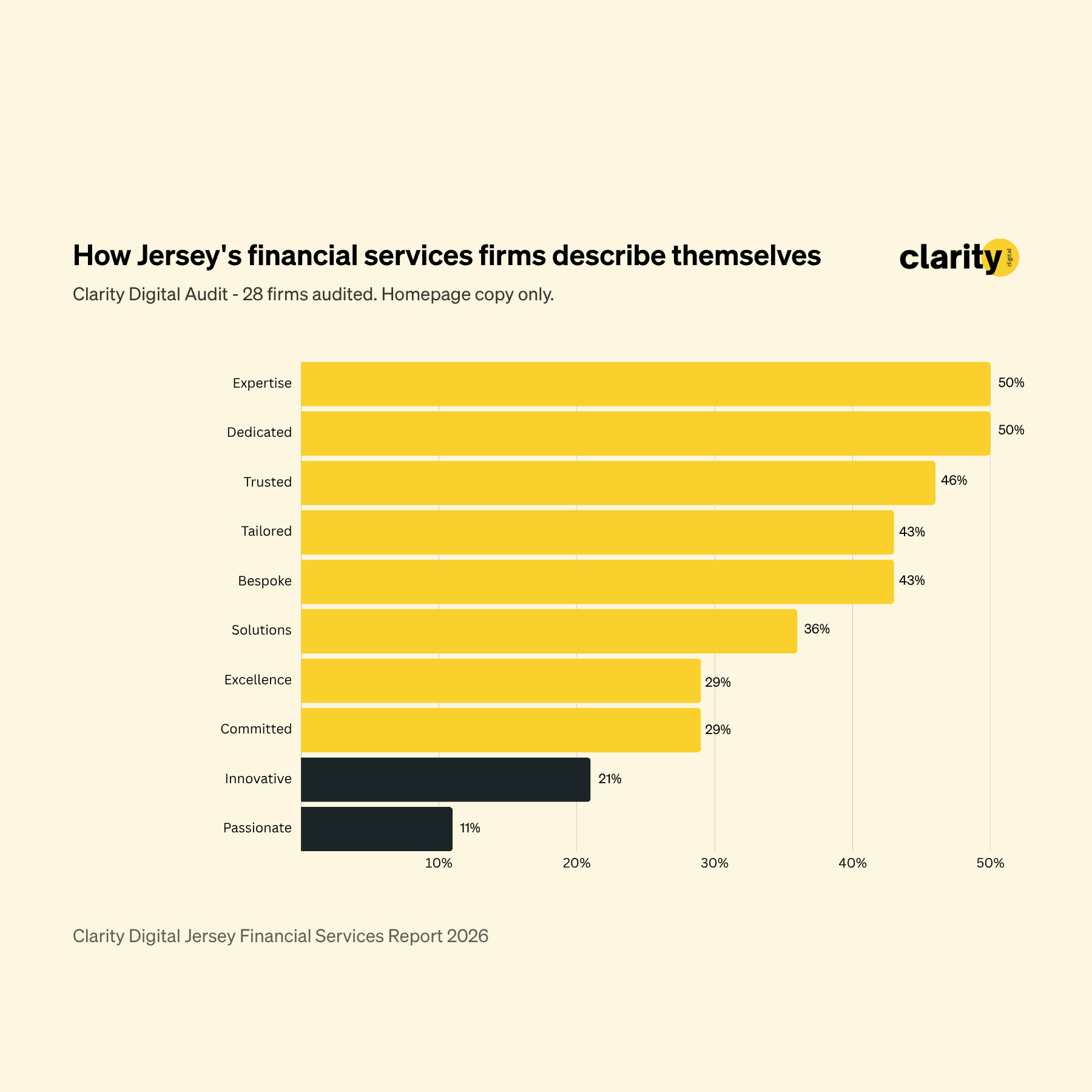
I compiled a list of ten words that appear frequently in financial services marketing. Words that sound substantial but carry no specific information.
Trusted. Expertise. Tailored. Bespoke. Innovative. Solutions. Excellence. Dedicated. Committed. Passionate.
93% of firms in this audit, 26 of 28, use at least one of them on their homepage.
The most common: expertise and dedicated, each appearing on exactly half of all homepages. Trusted on 46%. Tailored and bespoke on 43% each.
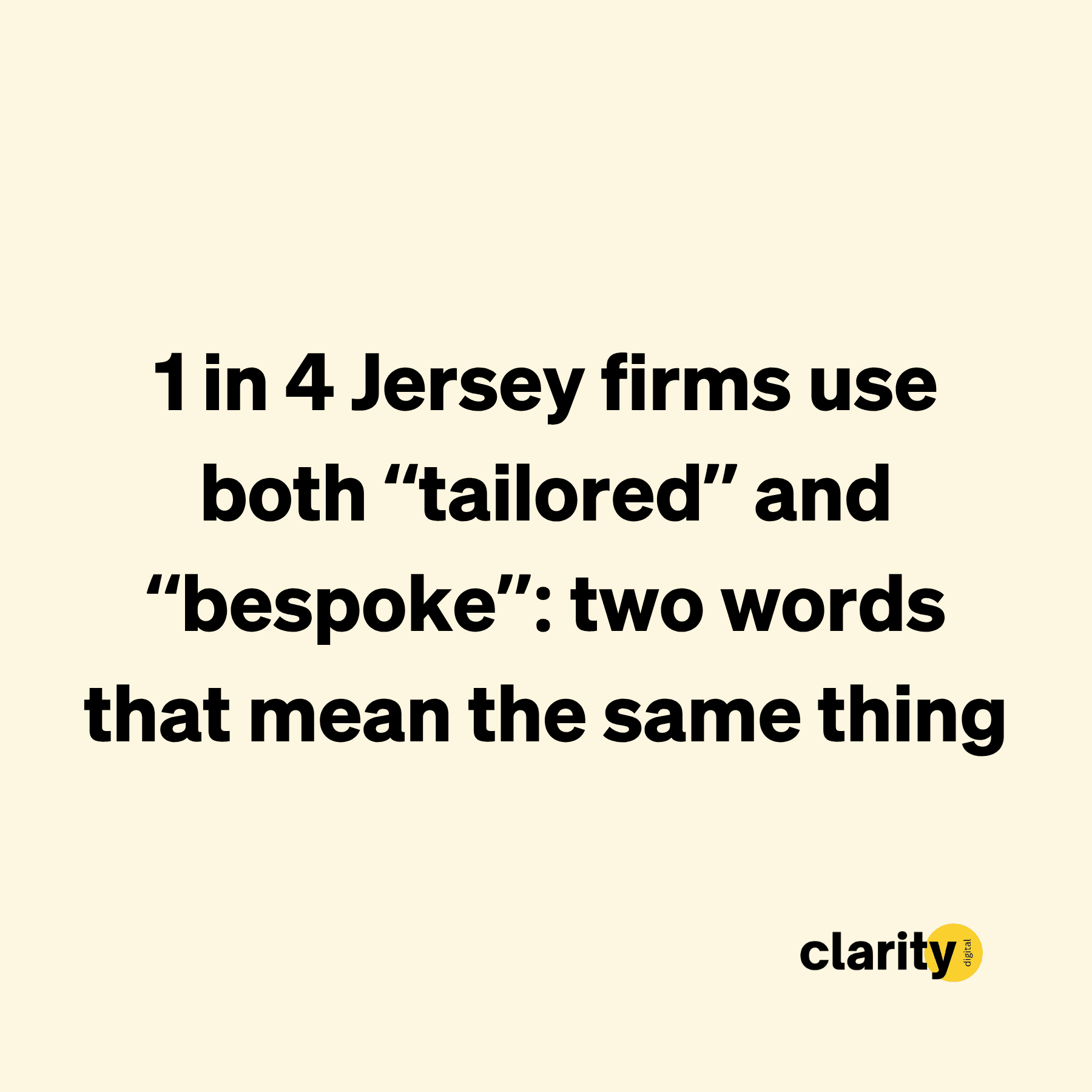
Strikingly, one in four firms uses both "tailored" and "bespoke" on their homepage: two words that mean the same thing.
I think of these words as the minimum bar. Every firm in this sector is trusted, experienced, and client-focused. Saying so doesn't help a stranger choose you. It confirms you've noticed the same language everyone else uses.
The sector has converged on a shared vocabulary that communicates nothing distinctive about any individual firm within it. A prospective client reading five homepages in a row would be forgiven for struggling to distinguish between them. Not because the firms are the same. Because the language is.
In a sea of brand sameness, too many firms rely on off-the-shelf claims about themselves. Words like "trusted", "bespoke" and "tailored" quickly become wallpaper to prospective clients trying to solve a problem.
Original language grounded in real value is what cuts through. The question every homepage should answer is simple: what can you do for me?

Finding 2: 43% fail the clarity test
We applied a simple test to each firm's homepage: could a senior buyer, with no referral and no prior knowledge, tell from the first screen what the firm does and who it serves?
43% of firms, 12 of 28, fail that test. The homepage doesn't communicate the basics within a reasonable reading of the first screen.
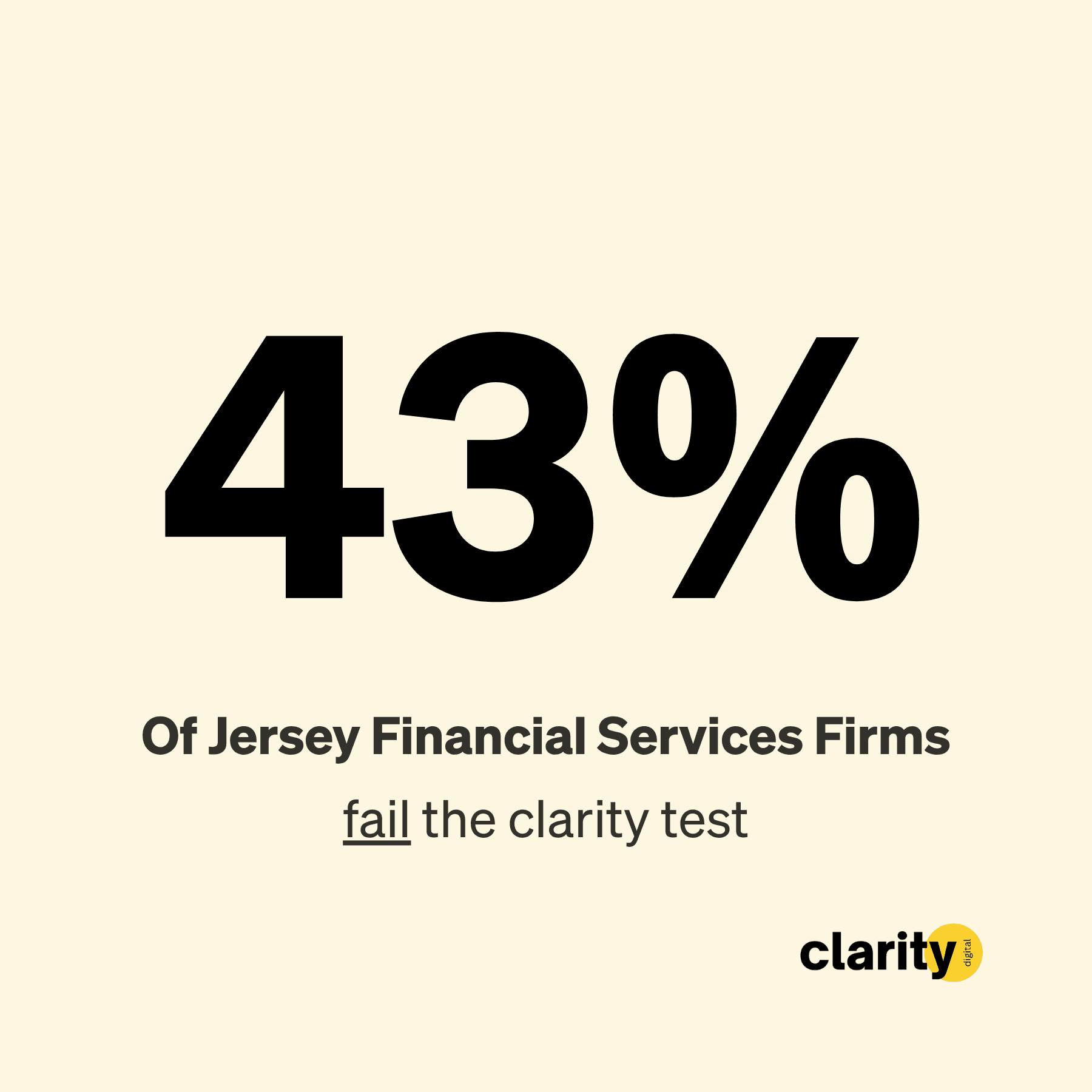
But passing the test is only the beginning of the problem.
The 16 firms that do communicate what they do clearly are still, in most cases, saying something almost identical to their competitors. "We are an independent provider of fund, corporate, and private client services." Clear. Not distinctive.
Most firms in this sector can communicate their category. Almost none communicate why a specific type of client should choose them over the firm next door. That is a harder problem, and a more revealing one.
A parallel audit of 20 Jersey law firms, run against a similar framework, found the same vocabulary convergence and the same weak calls to action. On proposition clarity, law firms scored four times higher than financial services firms did. They were more likely to state, in plain terms, what they did and who for, from the first screen. The financial services sector has more digital infrastructure: more content, more LinkedIn presence, more AI visibility. Law firms have less of it and use it better.
Finding 3: The CTA problem, and a technical one underneath it
The call-to-action gap
Every homepage ends with an ask. In 89% of the firms we audited, that ask is generic: "Contact us." "Get in touch." "Learn more."
A call to action is the bridge between a prospect's interest and their first step toward you. A vague one puts the entire weight of that decision on the visitor. They have to decide what to ask for, how, and whether it's worth their time. Most won't bother. A directional CTA, one that names what happens next, removes that friction. It says: here is the specific thing you'd be signing up for, and here is why it's worth five minutes of your time.
Only two firms in this audit use a CTA specific enough to do that work. The rest default to the functional minimum. One firm has no CTA at all.
The weak CTA is easier to explain when you see what surrounds it. 46% of firms (13 of 28) have no social proof on their website at all. No testimonials, no client names, no case studies, no awards. Nothing. A CTA asks a stranger to take a step. Social proof gives them a reason to. Most firms in this audit are asking for the step without providing the reason.
The performance problem
These are trust businesses. The entire commercial premise rests on earned credibility. Yet nearly half present no visible evidence of it to a stranger encountering them for the first time.
The first impression problem is not only a messaging problem. The average mobile PageSpeed score across the 28 firms is 57 out of 100. Only three firms score above 70. Six score below 50. One scores zero, indicating a site that often fails to render on mobile devices entirely.
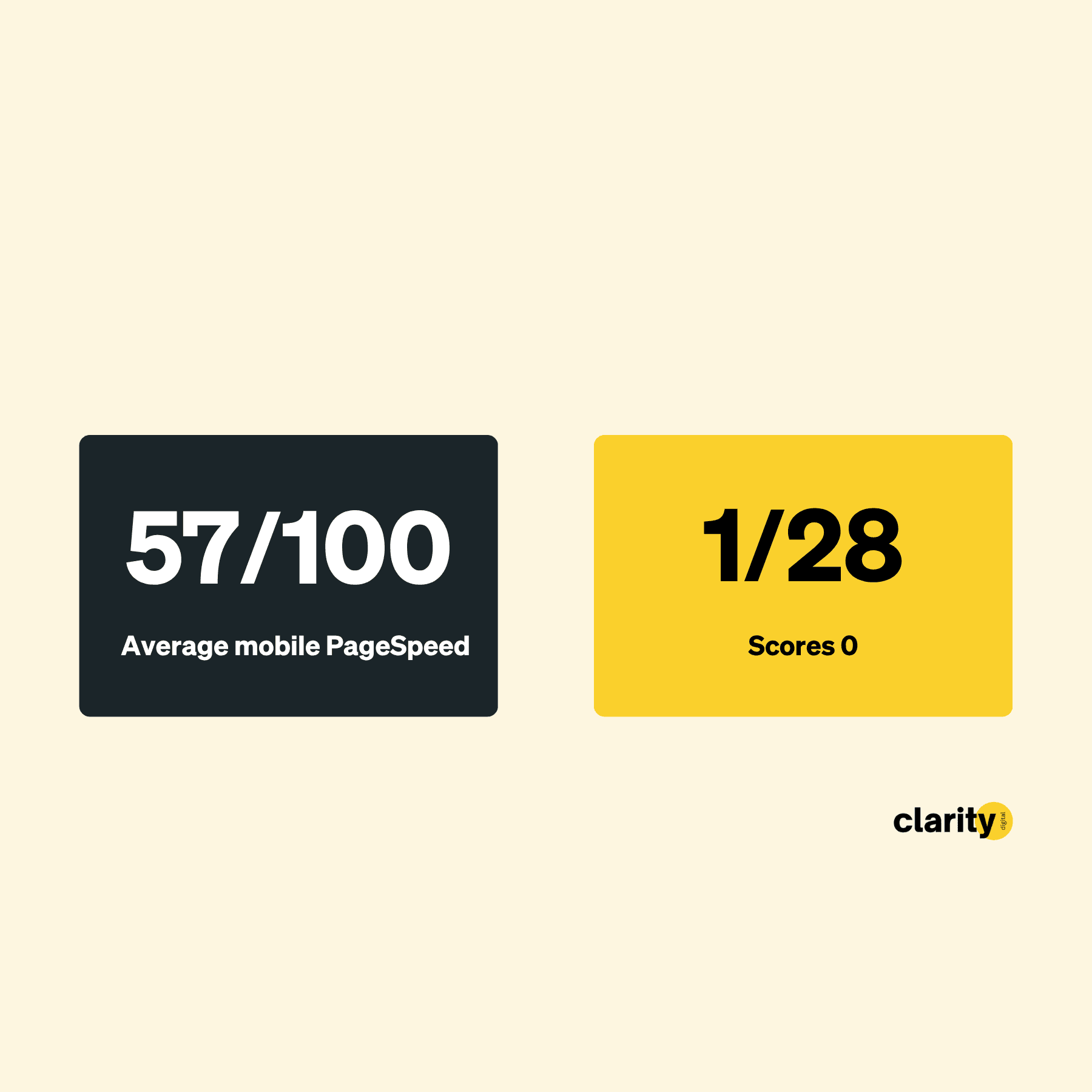
A cold prospect finding a firm through a search or a LinkedIn post is, statistically, likely to be on their phone. For most firms in this audit, the technical experience greets them before the words do.
Finding 4: LinkedIn is primarily a notice board. The numbers explain why.
How the sector uses LinkedIn
Across 28 firms, I categorised the dominant content type from recent LinkedIn posts.
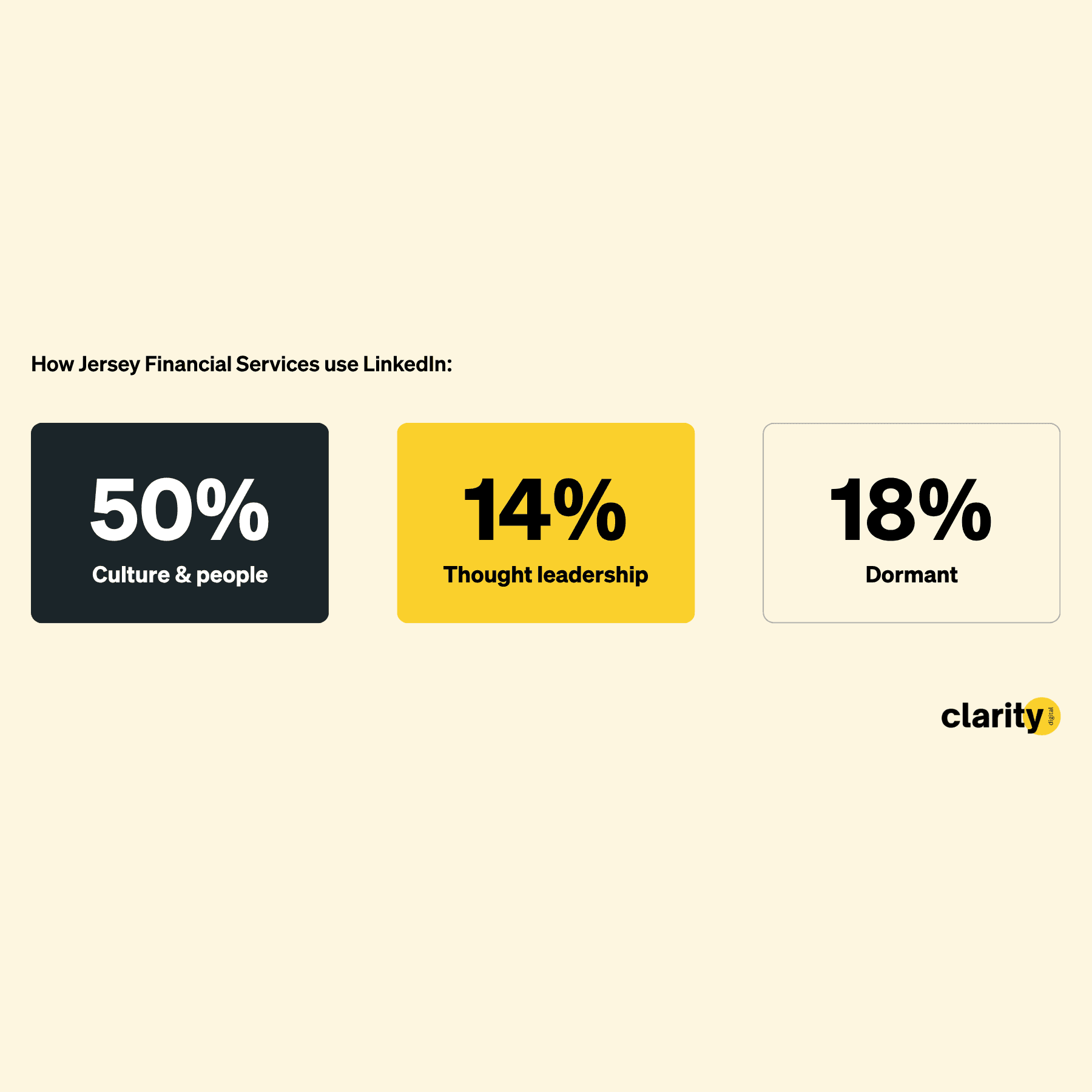
50% of firms, the single largest group, use LinkedIn predominantly for culture and people content: promotions, team spotlights, charity events, holiday greetings. A further 18% use it primarily for awards and recognition announcements. 18% are effectively dormant: no posts, or last activity more than three months ago.
Only 14% of the sector, four firms, use LinkedIn primarily for thought leadership.
What the engagement data shows
The engagement data suggests this is not just a missed opportunity. It is an active misdirection. The conventional wisdom is correct: birthday posts and work anniversaries reliably generate likes, and any marketer who tells you otherwise is wrong. But at firm level, rather than post level, the pattern is more complicated.
I measured average engagement rates across a sample of recent posts, filtering to firms with 500 or more followers. The averages look unremarkable: thought leadership firms generate around 2% per post, culture and people firms around 1.8%, awards firms around 0.3%. The range is where it gets interesting. Thought leadership firms sit in a band from 1.3% to 2.4%. Culture and people firms range from 0.2% to 5.7%. The highest-performing firm in the dataset posts people content.
Thought leadership tends to be steadier. It may not spike as dramatically, but it creates a more reliable floor of credibility over time. Culture content is more volatile: capable of a 5.7% spike or a 0.2% floor from the same strategy. The sector's largest LinkedIn presence, 82,000 followers, averages around 16 engagements per post. A thought leadership firm with 2,400 followers averages around 55. Sample sizes are small and the findings should be read as directional, but the pattern is clear enough to track.
How LinkedIn's algorithm is changing this
LinkedIn's incentives are moving to reinforce this. In early 2026, LinkedIn replaced its content ranking infrastructure with a 150-billion-parameter LLM system called 360Brew. It rewards accounts demonstrating sustained domain expertise and actively downranks generic posts and engagement-pod content. The birthday post still registers. The signal that now compounds is consistent, specific, expert content. Most Jersey financial services firms are not currently building that signal.
A hundred likes on a team birthday post does not move a prospective client closer to a conversation. The data is not saying thought leadership is rare and therefore automatically impressive. Most of what passes for thought leadership in this sector is too cautious, too inward-facing, or too generic to move anyone. A regulatory update posted without a point of view is not thought leadership. It is broadcasting with a better label. The firms doing it well are the ones with something specific to say and the willingness to say it clearly. That is a harder ask than posting a team anniversary. It is also the one that compounds.
Most professional services firms sound the same, use the same terms, and talk about the same things. The best performing firms on LinkedIn are the ones that show what makes them different, stand clearly behind their values, and get their people involved. Company posts travel further when employees share them with a comment on why the message matters.

Finding 5: Half of firms tell different stories on different channels
If a prospective client reads a firm's website and then visits their LinkedIn page, they should find a coherent picture. One story, told in two places.
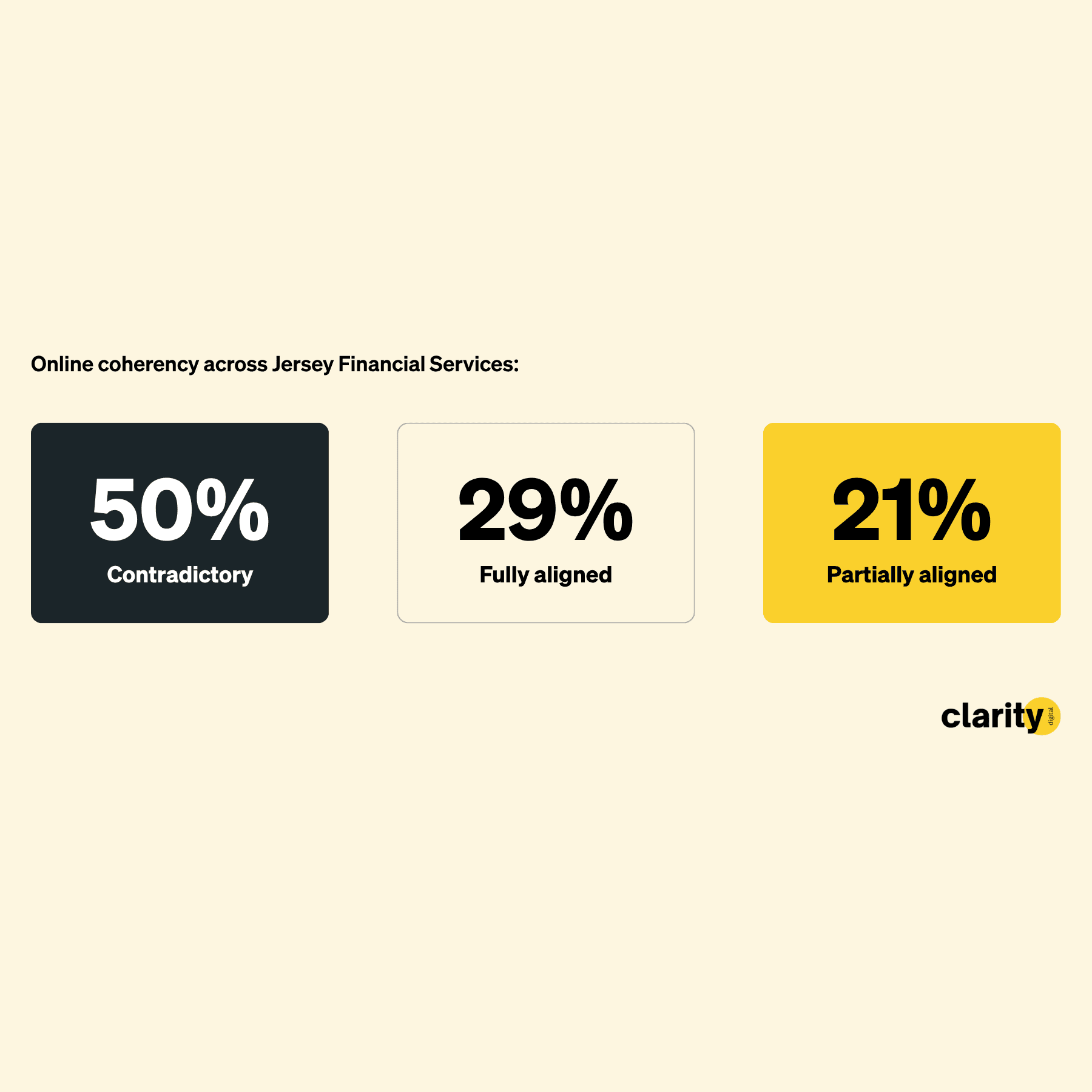
In 50% of the firms we audited (14 of 28), they find something different.
Not slightly different. Contradictory.
One firm's website is built around consumer-friendly language: simple, accessible, designed to demystify. Its LinkedIn page publishes dense institutional analysis of complex financial structures. A different firm's website promises the intimacy of boutique service. Its LinkedIn page is actively recruiting for high-volume fund processing roles.
Behind the inconsistency is an unresolved question: who are we, and who are we actually for?
When a prospect triangulates across channels, that question becomes their question too. And most prospects, faced with that uncertainty, will move on to the next firm on the list.
The full picture is more concerning than the headline figure suggests. Only 6 of 28 firms, 21%, are fully aligned across website and LinkedIn. A further 8 are partially aligned: not contradictory on service claims, but inconsistent enough in tone, audience, or emphasis that a careful reader senses something unresolved. 79% of the sector shows some form of incoherence between channels. The coherence problem is not a minority issue. It is the sector norm.
Finding 6: The D&I visibility gap
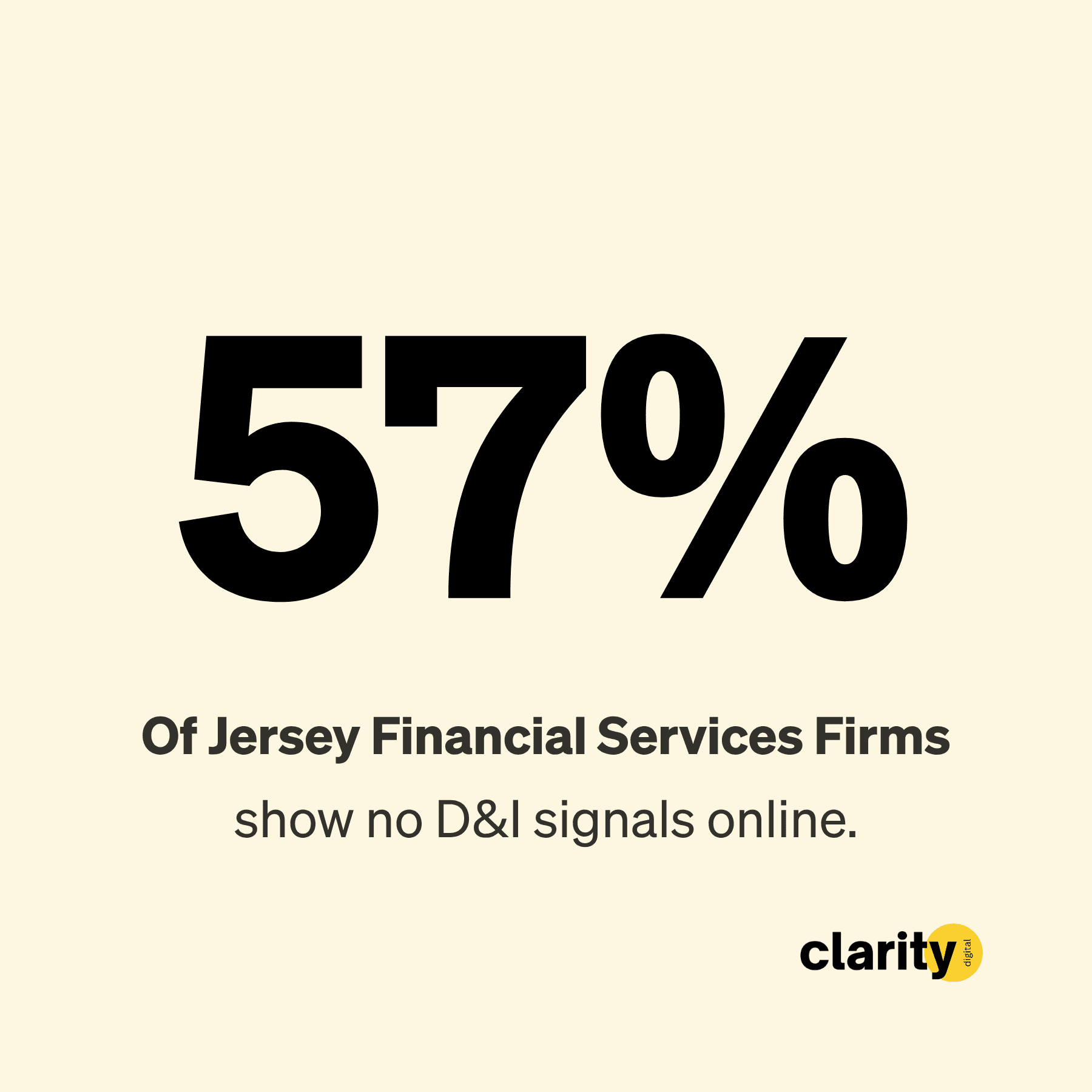
57% of the firms in this audit (16 of 28) show no visible D&I signals on their website or LinkedIn presence. No diversity statements, no demographic information, no structured commitments.
Of the remaining firms, most show token gestures: a single International Women's Day post, one line about embracing openness, a mention of values without any accompanying evidence.
Zero firms demonstrate measurable D&I outcomes. No targets, no tracking, no direction of travel.
One firm stands apart, publishing actual progression data: quantified promotion demographics with year-on-year movement. That is not a performative statement. It is evidence of a process.
For most firms, this is a visibility problem rather than a values problem. Strong internal cultures exist behind websites that say nothing about them. But for a family office, fund manager, or regulatory body conducting ESG due diligence on their service providers, visibility is the only thing that can be assessed. What isn't communicated effectively doesn't exist in that process.
As institutional clients embed ESG accountability requirements into their vendor selection, this gap will shift from a communication issue to a commercial one.
Finding 7: The Jersey identity may be working against you online
This finding emerged from the data and was not part of the original hypothesis.
What the visibility data showed
Firms in the audit were categorised by how prominently they position Jersey in their identity. Some lead with it as a differentiator: Jersey heritage, island roots, local expertise. Others mention it without making it central. A few downplay it almost entirely, positioning for international audiences rather than the local market.
The AI visibility data told a consistent story:
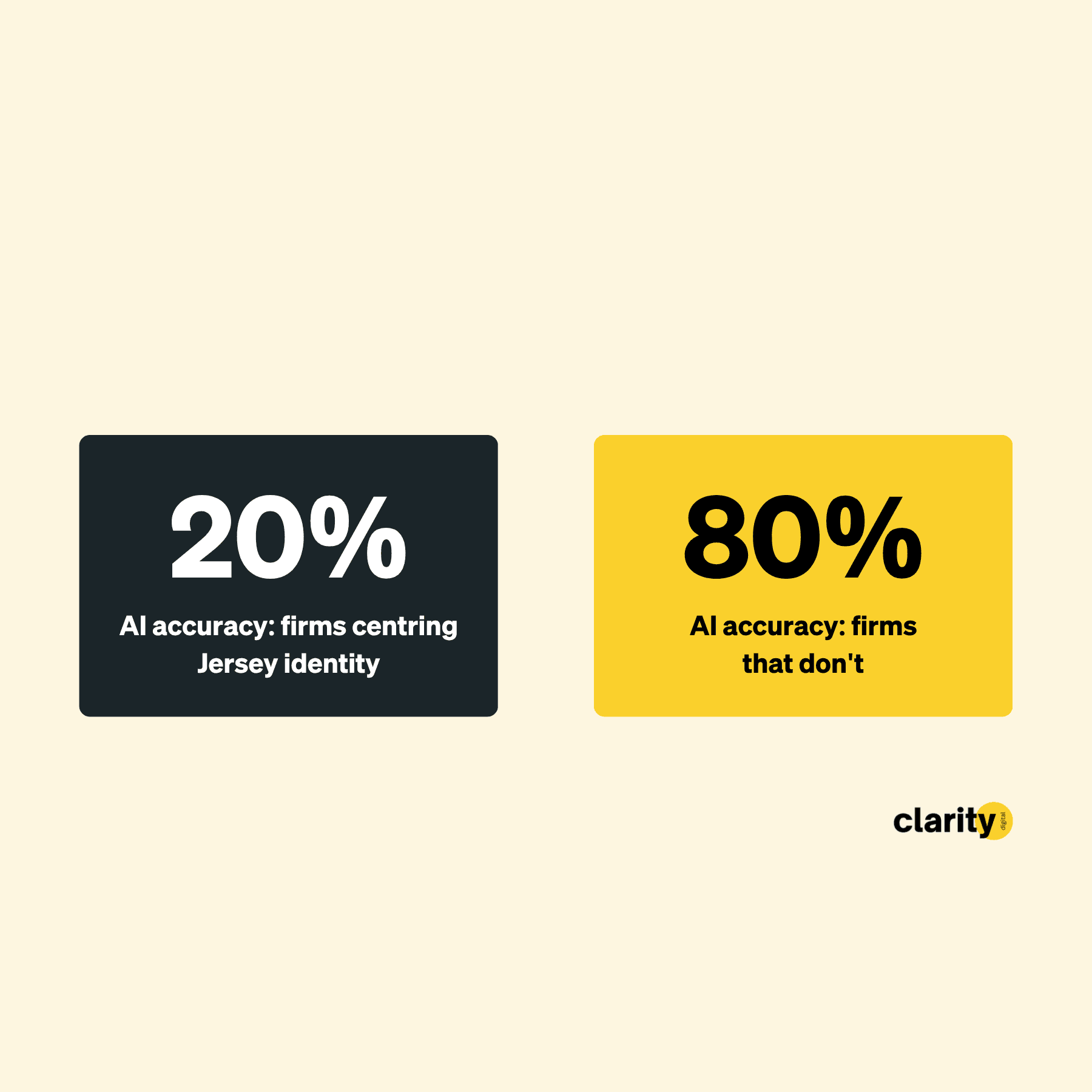
Firms that foreground Jersey in their positioning were rated "strong and accurate" by AI in 20% of cases. Firms that mention Jersey without centring it: 54%. Firms that downplay Jersey as a primary identity: 80%.
The more a firm centres its Jersey identity, the less likely AI is to describe it accurately or favourably.
What this means for your positioning
The probable mechanism is not complicated. An identity built around heritage and location produces less specific, less indexable content. "We are a Jersey firm with deep roots in the island" gives an AI model nothing to synthesise. Specific claims about client types, service structures, and what makes the firm different from the next one give it something.
This does not mean firms should abandon their Jersey identity. It means a Jersey identity alone, without specific claims underneath it, is not a differentiator. Not for a stranger arriving without a referral. And not for an AI constructing a summary from everything publicly written about you.
Finding 8: AI has become an adversarial diligence partner
What the AI responses looked like
When I ran the buyer intent query, asking ChatGPT from the perspective of a prospective client what it could tell me about each firm, the results were not what I expected.
For many firms, ChatGPT did not just describe the business. It coached the buyer on how to scrutinise it. Due diligence checklists. Specific questions to raise. Structural vulnerabilities to probe. Information the firm's own website never acknowledges.
Half the firms in this audit, 14 of 28, received AI responses categorised as "present with concerns." That is not a tail of edge cases. It is the median outcome for a firm in this sector. When a prospective client asks an AI assistant about a Jersey financial services firm before a first meeting, there is a coin-flip chance the AI is surfacing risks they did not know to look for.
For a meaningful number of firms, the response surfaced regulatory history as a prominent finding: enforcement actions, ownership changes, leadership transitions. This information is in public records. ChatGPT has synthesised it. And it presents it, unprompted, to anyone asking the right question.
The narrative you didn't author
The website says nothing. The AI says something specific. That gap is no longer theoretical.
This is not a visibility problem in the conventional sense. These firms are visible. The question is what a prospective client finds when they look.
Firms spent decades managing their story through websites, brochures, and pitch decks. They controlled the first impression. AI has created a parallel narrative they did not author, cannot edit, and in many cases did not know existed. For some, that narrative is accurate and helpful. For others, it introduces concerns that the firm's own materials have never thought to address.
A website that is vague, generic, and unmanaged does not just fail to impress. It leaves a vacuum that other sources fill. And those sources do not necessarily tell the story the firm would choose to tell.
The answer is to be the most accurate, specific, and current version of your own story. When a model is trained on public information about you, it should find something worth finding. That starts with your website, your LinkedIn, and the coherence between them.
Understanding what AI currently says about your firm, and where that diverges from your own positioning, is where this kind of work starts.
The website is no longer the whole story. AI systems are looking for corroboration across search, LinkedIn, Reddit, YouTube and other public conversation sources. If those signals do not match what a firm says about itself, the model may either ignore the firm or describe it through a narrative the firm has not shaped.

What the data is actually saying
Every finding in this audit points to the same root cause.
These firms built their digital presence for people who already knew them. The website was designed to confirm what a referral had already suggested. It didn't need to introduce the firm to a stranger, because strangers were not the audience.
That model works. For a long time, it works extremely well. Jersey's financial services sector has produced some of the most sophisticated and trusted firms in the world, largely through relationships, reputation, and word of mouth.
The website was never given a job to do beyond that. So nobody checked it. Nobody updated the language. Nobody coordinated the LinkedIn page with the service page. Nobody asked what a complete stranger would make of it.
In a world where a prospective client in London, Singapore, or Dubai might find you through a search, a cold introduction, or an AI query before they've spoken to anyone who knows you, that passivity has a cost it didn't used to have.
Most of these businesses are considerably better than their marketing suggests. The gap is between the quality of what they do and the clarity of how it comes across to someone encountering them for the first time.
That gap is closeable. And for the firms growing beyond Jersey's referral networks, closing it is no longer optional.
What good looks like
A handful of firms stood out. Not the largest, not the most resourced, not sharing a sector or a style.
What they share is clarity of intent. They are not hiding behind their category. They have made the difference easier to feel. Through the words they choose, the structure of their services, the specific thing they ask a visitor to do next.
A strong digital presence is not luck, and it is not the preserve of firms with large marketing budgets. It is almost always the visible result of a few clear decisions, made properly and expressed well.
Most firms in this audit are doing better work than their websites suggest. The question is whether someone landing cold would sense that: would feel they had found a firm with a point of view, one that knew what it was and had taken the time to say it clearly.
For most firms, the honest answer is not quite yet.
How your firm compares
I am offering a short diagnostic conversation, free, no pitch, to the first ten firms who get in touch after reading this.
In thirty minutes, we will look at where your firm sits against the criteria in this audit: what is working, what AI currently says about you, and where the most significant gaps are. You leave with a clear picture of your starting point.
If that conversation leads somewhere, it leads to the Clarity Reset, a structured 30-day engagement that addresses the foundations: positioning, messaging, and digital coherence.
If it doesn't, you still have the diagnosis.
Book a 15-minute Clarity Call →
Frequently asked questions
How were the 28 firms selected?
Firms were selected from the JFSC register, covering a range of sizes, structures, and service types: from large international platforms with hundreds of billions under administration to boutique trust companies run by a handful of directors. The sample was designed to reflect the breadth of the registered sector rather than target any particular category of firm.
Were firms contacted before publication?
No. All data was collected from publicly available sources: firm websites, LinkedIn company pages, and AI assistant responses. No firm was briefed, consulted, or given the opportunity to respond prior to publication. No firm paid to be included or excluded.
What does "AI visibility" mean in practice?
For this audit, AI visibility refers to what an AI assistant (specifically ChatGPT, in a fresh temporary session to avoid history bias) says about a firm when asked two questions: a general awareness query, and a buyer intent query from the perspective of a prospective client. The responses were assessed for accuracy, completeness, and whether they surfaced information the firm's own website does not address.
What did the best-performing firms have in common?
They were not the largest, the most resourced, or concentrated in any particular sector. What they shared was clarity of intent. They had made deliberate decisions about who they were for, stated that plainly, and maintained coherence between their website and LinkedIn presence. Strong digital performance in this sector is almost always the result of a small number of clear decisions made properly, not budget.
How is this different from a standard website audit?
Most web audits focus on technical performance, SEO metrics, or design quality in isolation. This audit evaluated digital presence as a commercial system: the coherence between what a firm says about itself, how it behaves on LinkedIn, and what AI constructs about it from public sources. The question throughout was not "does the website work?" but "does the digital presence do the job a cold prospect needs it to do?"
James Logue is the founder of Clarity Digital, a strategic marketing consultancy based in Jersey that helps professional services firms bring their external presence up to the standard of the business behind it.
Need the same clarity in your own firm?